
Symphony by Wix: AI marketing agents for small businesses

Paid partnership
- What it is
- An AI agent platform from Wix in which a central agent, Maestro, builds a team of specialist agents around one business and coordinates them from one conversation
- Designed for
- Taking the recurring marketing work — posting, emailing, following up, reporting — off an owner who is doing it alone
- Built for
- Individuals and small businesses of up to 10 people; the business does not need a Wix website
- How it works
- Describe the business → Maestro proposes and hires agents → connect email, social, calendar and analytics from cards in the chat → agents draft and schedule → you approve, or set routine actions to run
- Main consideration
- Agents' background work is metered in AI credits; the free plan stops at 100 a day, and the paid tiers lift the daily cap
Who Symphony by Wix fits
Symphony by Wix fits a small business whose marketing is done by the owner, in the gaps between the actual work, and who wants it planned, drafted, sent and reported on by agents rather than by a stack of separate tools.
Wix positions it for solo operators and small businesses of up to 10 people in any industry — service providers, coaches, consultants, local businesses and online sellers — and as the way for independent business owners to build, manage and scale without a team behind them. The audience it describes is the person who is the business, for whom every hour spent on operations is an hour not spent on the work itself. In Cllimber's test on 11 September 2026, asked what it could take off a small business's plate across marketing, Maestro answered with seven areas: content, email, brand assets, launch campaigns, audience building, analytics and "the day-to-day" of replying to messages, following up leads and chasing reviews.
It is not built for larger businesses. Wix positions it for solo operators and teams of up to 10, and a marketing department with its own tooling, sign-off chains and agency relationships is outside that: the workspace, the approval flow and the credit plans are all sized for an owner and a handful of people.
The trade-off is that the agents are metered. Chatting with Maestro is free, but every draft, send and scheduled run spends AI credits, and the free plan caps them at 100 a day; agents pause when credits run out. A business that wants its marketing agents running every day is on a paid tier, which lifts the daily cap. The second trade-off is that the sending happens through tools you connect — your inbox, your email platform, your social accounts — so the value arrives connection by connection.
What sets Symphony by Wix apart for small-business marketing, and what should you weigh?
The distinguishing design is one conversation on the surface and a team underneath. Maestro "identifies what needs attention next, and coordinates the right specialized agent for each job"; the agents share context with each other, so what the customer-messages agent learned last week informs what the marketing agent sends this week; each morning they regroup to summarise what was done and surface opportunities; and a quality-review layer has a second agent check work before the owner sees it. Six areas are built in — outreach, marketing, scheduling, research, finance and design — and custom agents can be created and trained on the owner's tone and rules, with a name and a personality of their own. The expertise behind them, in Wix's account, is "20 years of Wix knowledge from over 300 million businesses across every industry".
What to weigh is that the platform is proactive by design: it surfaces suggestions and drafts actions without being asked, and it notifies you when a decision is needed. For anything that matters, approval is built into the flow, and in the test Maestro said routine actions can be set to run without it. The choice of what counts as routine is the owner's, and it should be made before a live inbox is connected.
One chat assembles the marketing team; the credit plan and the connections decide how much it does each day.
What are AI marketing agents for small businesses?
AI marketing agents for small businesses are software that carries out multi-step marketing work on the business's behalf, within limits the owner sets: drafting and scheduling social posts, writing and sending email campaigns and automated sequences, capturing and following up leads, building an audience, producing brand assets, and reporting on what worked, for a small business or SMB of any kind. They differ from an AI writing assistant in that they act: an agent sends, schedules, follows up and reports, rather than drafting text for the owner to place. Two kinds exist: a single agent inside one marketing tool, such as an email platform or a chat widget, and a platform that coordinates several AI agents for small business across the tools an independent business owner already uses.
Symphony by Wix belongs to the second kind. Rather than adding an AI feature to one channel, it puts an orchestrator, Maestro, above all of them: it works out what the business needs, staffs each job with an agent, wires those agents into the email, social and analytics accounts already in use, and routes the resulting drafts and actions back for a decision. Wix describes it as the connective layer across a business's whole operation, covering marketing automation alongside outreach, scheduling and finance, and it runs on iOS and Android as well as desktop. A Wix website is not required.
Sources: wix.com/symphony; launch announcement, 11 Aug 2026. Read 11 Sep 2026.
Examples of AI marketing agents for a small business
AI marketing agents for small businesses come in five kinds. Four do a job: a social content agent drafts and schedules posts and keeps a content calendar (in Symphony by Wix, Ava); an email and campaign agent plans campaigns and runs the automated sequences behind them, such as cart recovery and win-back (Olivia); a lead and customer-messages agent replies to enquiries, follows up leads and chases reviews (Sage); and a reporting agent reads analytics and produces a daily briefing (Maestro's morning meeting). The fifth kind is the multi-agent platform that coordinates the other four from one place, so the owner deals with one orchestrator rather than four tools. Symphony by Wix is that fifth kind, built for owners rather than developers: the agents are pre-built and hired from a chat, and no workflow is assembled by hand. Symphony's plans run from $0 to $100 a month, metered in credits; the pricing section below has the detail.
| Kind of AI marketing agent | What it does for a small business | Example in Symphony by Wix |
|---|---|---|
| Social content agent | Drafts and schedules posts; keeps a content calendar around launches and seasons | Ava, the social content agent |
| Email and campaign agent | Plans campaigns; runs automated sequences such as cart recovery, post-purchase and win-back | Olivia, the marketing manager |
| Lead and customer-messages agent | Replies to enquiries and DMs, follows up leads, chases reviews | Sage, the customer messages agent |
| Reporting agent | Reads analytics; produces a daily briefing on what was done and what worked | Maestro's daily morning meeting |
| Multi-agent platform | Coordinates the four kinds above from one place, with one orchestrator and one approval flow | Symphony by Wix itself, run by Maestro |
Kinds from the definition above; Symphony examples from Cllimber's test on 11 September 2026 and wix.com/symphony.
How do AI marketing agents for a small business work?
AI marketing agents for a small business work in four steps, whichever platform runs them. The owner describes the business and connects the tools it already uses: an inbox or email platform, social accounts, a calendar, analytics. An orchestrator works out what needs doing and hands each job to a specialist agent. The agents draft, schedule and send through the connected tools, in the background. Anything that matters comes back to the owner for approval before it goes out, and the platform reports what was done. The work is metered, usually in credits, so the plan decides how much the agents can do in a day.
In Symphony by Wix the orchestrator is Maestro, the specialist agents are hired from the chat with one click, the connections are made from cards Maestro places in the conversation, and the report is a daily morning meeting. In Cllimber's test the whole setup happened inside the chat and took about an hour; what follows is what came back.
Tested by Cllimber: what Symphony offered a small business's marketing
On 11 September 2026 a Cllimber tester on the free plan described a new small business to Maestro, accepted the four agents it proposed, opened the connectors page, and then asked one question: what could Symphony take off the plate of a small business across the whole marketing picture. The session took about an hour and never left the chat window.
What came back. Maestro's answer to the marketing question ran to seven areas, each attached to a named agent or tool. Content: Ava "drafts and schedules social posts, keeps your feeds active on a consistent cadence, and builds a content calendar around your launches, seasons, and moments". Email: Olivia runs campaigns for "new arrivals, promotions, seasonal offers" and the automated sequences behind them, "abandoned cart recovery, post-purchase follow-ups, win-back messages for lapsed customers".
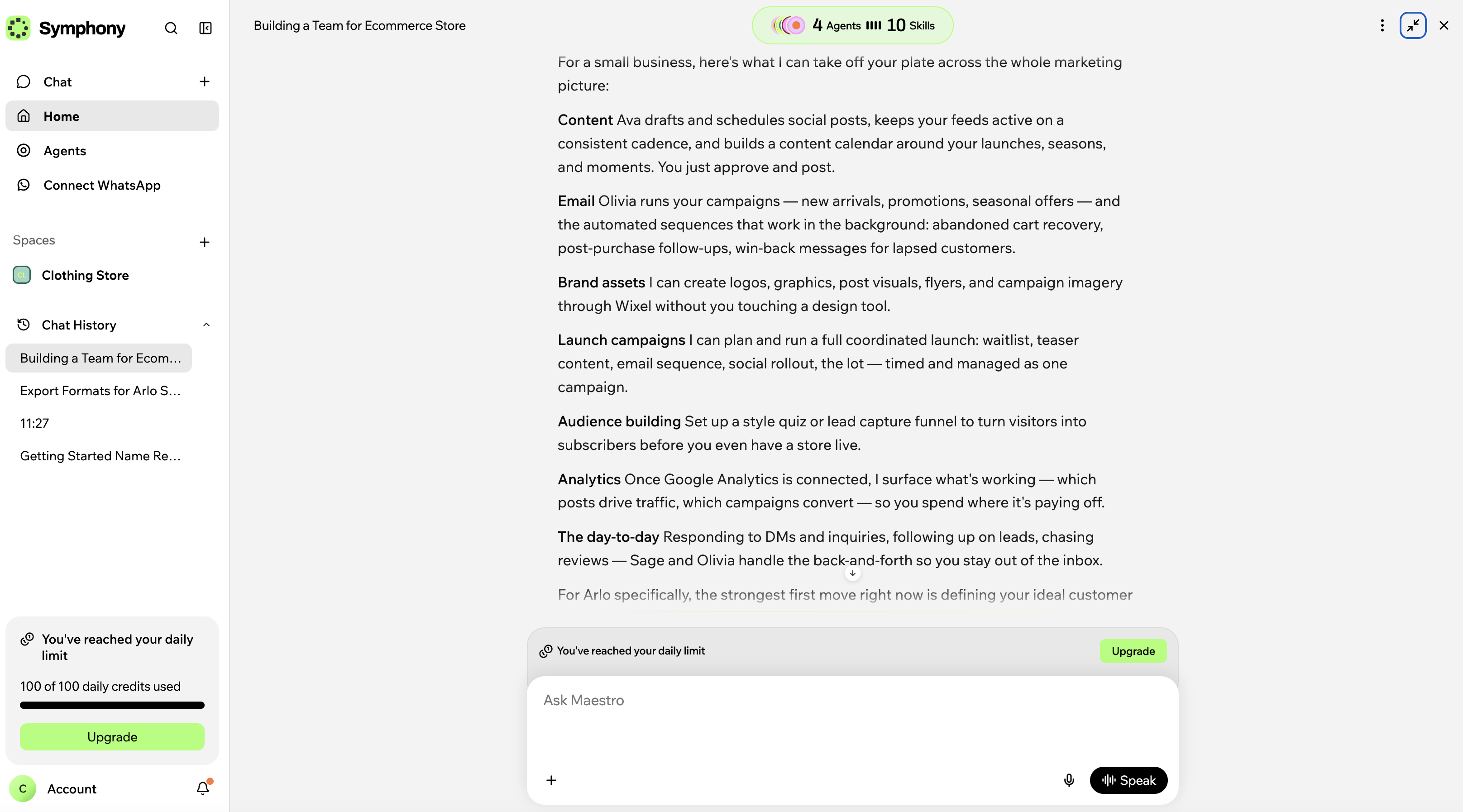
Brand assets: logos, graphics, post visuals, flyers and campaign imagery "through Wixel without you touching a design tool". Launch campaigns: "waitlist, teaser content, email sequence, social rollout, the lot — timed and managed as one campaign". Audience building: "a style quiz or lead capture funnel to turn visitors into subscribers before you even have a store live". Analytics: once Google Analytics is connected, "which posts drive traffic, which campaigns convert". The day-to-day: "responding to DMs and inquiries, following up on leads, chasing reviews", handled by Sage and Olivia "so you stay out of the inbox".
Connectors. The Connectors & MCPs page listed 66 tools available to connect, split into Tools and Channels, with a button to connect a custom MCP server. Cards seen on the first screen: Gmail, Google Calendar, Outlook Calendar, Apple Calendar, Instagram, Facebook, LinkedIn, Google Drive and Google Sheets; the diagram above them showed WhatsApp, Gmail, Calendar and Wix among the connections and a "+63" counter. Each connection is authorised in the browser from a card, and "any agent can start using it" once made.

Credits. The marketing question was asked at the end of a session in which the same free account had already been used to set up and test an online store, and that earlier agent work had spent the day's allowance: the sidebar read "100 of 100 daily credits used" and the chat carried a banner, "You've reached your daily limit", with an Upgrade button. Maestro still answered in full, because chatting is not metered; only the agents' background work is.
What we didn't test. No email platform, social account, calendar or analytics account was connected, so no campaign was sent, no post published, no lead captured and no report produced. Wixel image generation was not run. The custom MCP server option was not used. The mobile app was not used. Sage's and Olivia's handling of messages and leads was described, not observed.
Anyone can put the same marketing question to Maestro on the free plan at symphony.co.
Why small businesses use AI marketing agents, and why now
Most US small businesses already use generative AI, and mostly for writing. What a marketing agent adds is the rest of the job — scheduling, sending, following up and reporting — which is the work still done by hand. These figures describe the market, not Symphony.
What does Symphony by Wix bring together for small-business marketing?
| Capability | What Symphony by Wix provides |
|---|---|
| Orchestrator | Maestro: one chat that learns the business, proposes agents, dispatches work, mints connection links and asks for approval |
| Built-in agent areas | Outreach, marketing, scheduling, research, finance and design, pre-configured and available from the first conversation |
| Content and social | A social content agent that drafts and schedules posts and builds a content calendar around launches and seasons |
| Email marketing | Campaigns plus automated sequences — cart recovery, post-purchase, win-back — sent through a connected email platform or inbox |
| Lead capture and follow-up | A style quiz or lead-capture funnel to build a subscriber list; agents that reply to DMs, follow up leads and chase reviews |
| Brand assets | Logos, graphics, post visuals, flyers and campaign imagery produced through Wixel, which runs on its own credits |
| Launch campaigns | Waitlist, teaser content, email sequence and social rollout planned and timed as one campaign |
| Analytics | With Google Analytics connected, reporting on which posts drive traffic and which campaigns convert; a per-business dashboard with real-time trends and growth metrics |
| Routines and the morning meeting | Scheduled recurring work; a daily meeting in which agents summarise completed work and flag opportunities |
| Connectors | 66 available to connect on the day of the test, in Tools and Channels, plus a custom MCP server option |
| Custom agents | Agents you create and train on your tone and rules, with their own name and personality, running alongside the built-in team |
| Workspaces and team | A space per business or goal with its own agents, files and threads; team members with roles and permissions |
| Approval and notifications | Suggestions and drafts come to the owner; notifications when a decision is needed; routine actions can be set to run without approval |
| Mobile | iOS and Android apps |
Sources: wix.com/symphony; Symphony pricing page; Symphony agent types; Cllimber test. Read 11 Sep 2026.
What can Symphony by Wix's marketing agents do for a small business?
1. Content creation and social media management
Ava, the social content agent, "drafts and schedules social posts, keeps your feeds active on a consistent cadence, and builds a content calendar around your launches, seasons, and moments. You just approve and post." Marketing agents in the built-in team "draft campaigns, write social copy, manage editorial calendars and generate content across formats". Posting goes through the social accounts you connect — Instagram, Facebook and LinkedIn were on the first screen of connectors, and TikTok was offered during setup.
Drafting and scheduling are the agent's; approval and the connected accounts are yours.
2. Email marketing automation
Olivia, the marketing manager, "runs your campaigns — new arrivals, promotions, seasonal offers — and the automated sequences that work in the background: abandoned cart recovery, post-purchase follow-ups, win-back messages for lapsed customers". She sends through what you connect: a bulk email platform for campaigns and list management, or a personal inbox such as Gmail or Outlook for one-to-one follow-ups. For a store, the same agent's cart-recovery and order sequences are covered in Symphony by Wix: AI agents for online stores. Symphony also acts as "your ai email assistant for outreach and client comms".
Campaigns and sequences are planned and sent by the agent, through your existing email tool.
3. Lead capture, qualification and follow-up
For audience building, Maestro offered to "set up a style quiz or lead capture funnel to turn visitors into subscribers before you even have a store live". For the day-to-day, Sage and Olivia handle "responding to DMs and inquiries, following up on leads, chasing reviews". Outreach agents in the built-in team cover "client communications, lead follow-ups, appointment confirmations and reminders", and a scheduling agent can "monitor booking flows and trigger automated reminders and follow-up sequences".
Capture, reply and follow-up are split across agents that share what each one learns.
4. Brand assets and launch campaigns
Visuals — "logos, graphics, post visuals, flyers, and campaign imagery" — are produced through Wixel, a separate Wix product that runs on its own credits, without opening a design tool. A launch is planned as one campaign: "waitlist, teaser content, email sequence, social rollout, the lot — timed and managed as one campaign". Design agents in the built-in team generate "brand-consistent visual assets" and adapt content across channels.
Words and plans come from the Symphony team; anything visual is made in Wixel and billed to Wixel's credits.
5. Analytics, ad performance and the daily briefing
With Google Analytics connected, Maestro "surfaces what's working — which posts drive traffic, which campaigns convert — so you spend where it's paying off", and during setup it offered to read Google Ads and Analytics data "so you're not guessing where to spend". Each morning the agents regroup to summarise completed work and highlight opportunities, and a per-business dashboard shows real-time trends and growth metrics as work accumulates.
Reporting arrives as a daily briefing and a dashboard, not as a report you pull.
AI agent platform or a single marketing tool: which does a small business need?
A single marketing tool with an AI feature — an email platform that writes subject lines, a social scheduler that drafts captions — does one job inside one product, and the owner still moves between tools. An agent platform sits above them: an orchestrator decides what needs doing, dispatches an agent, and the agent works through the tools the business already uses. The first is judged on how good its one feature is; the second on how much of the marketing week it carries and how it reports back.
Symphony by Wix is the platform kind. Its output comes back as drafts, schedules, tasks and actions to approve, and the agents share context, so "your marketing agent knows what your front desk agent learned last week" about the customers who matter most. The consequence is that it depends on connections — an inbox or email platform, social accounts, analytics — and that its background work is metered in credits.
A tool with AI does one job well; Symphony coordinates the jobs and needs your tools connected to do it.
| Kind of tool | Where it lives | Setup | Approval | What it connects to | Pricing model |
|---|---|---|---|---|---|
| Website chatbot | A widget on the site, talking to visitors | Add the script, load a set of answers; working the same day | Replies on its own; nothing waits for you | The site's pages and an enquiry form | Flat monthly charge, sometimes priced by conversation volume |
| Single-tool AI feature | Built into one product, such as a scheduler that suggests captions | No setup; it comes with the product | It suggests, you publish | That product's own accounts and nothing beyond them | Part of the plan you already pay for |
| Helpdesk or inbox agent | Inside the shared inbox | Authorise the inbox and let it learn from past replies | Sends within the rules you give it | Inbox, CRM and booking calendar | Charged per seat, or per conversation it resolves |
| Multi-agent platform (Symphony by Wix) | With the owner, above the marketing tools | Describe the business in a chat; agents are proposed and hired | Drafts and actions come to the owner first; routine ones can be set to run | Email platform or inbox, social accounts, calendar, analytics — 66 connectors on the day of the test | Free plan, then $20 to $100 a month ($16 to $80 a month billed yearly), metered in AI credits |
Kinds of tool compared, not vendors. Symphony by Wix column from wix.com/symphony and Cllimber's test; the other kinds describe the category.
“One conversation on the surface; underneath, a marketing team that drafts, schedules, sends through your tools and brings the decisions back to you.”
How to use AI agents to market a small business
Using AI agents to market a small business takes six steps, whichever platform runs them: start, describe the business, hire the agents, connect your channels, give the first brief, and let the routines run. The specifics below are from Symphony by Wix, where Maestro followed this sequence in Cllimber's test.
- Start free: no credit card; 500 credits a month, 100 a day. Start with Symphony by Wix.
- Describe the business: what it does, who it sells to, what platform it runs on if any. Maestro creates a space and proposes a team.
- Hire the team: one click hires the proposed agents; in the test the team for a new brand was an orders agent, a customer-messages agent, a marketing manager and a social content agent.
- Connect your channels: email (an inbox or a bulk platform), social accounts, calendar and Google Analytics, each from a card in the chat and authorised in the browser. 66 connectors were available on the day of the test.
- Give the first brief: a content calendar, a launch, a win-back sequence or a lead-capture funnel; the agent drafts, you approve.
- Let routines run: the daily meeting summarises what was done and surfaces what needs attention; the dashboard fills as work accumulates.
How much do AI marketing agents for a small business cost? Symphony by Wix pricing
Symphony sells four tiers metered by AI credits, billed monthly or yearly, with yearly billing 20% off. Chatting with Maestro is free; credits are spent when agents do background work — running a task, reaching out to a contact, building or running an automation — and the amount depends on the complexity of the action and the tool used. Prices are in US dollars, per month. The first figure is what you pay on a rolling monthly plan; the second is what each month costs when you pay for a year upfront, which is 20% less. Prices below are from the Symphony pricing page, US, read 11 September 2026, and exclude tax.
| Plan | Monthly (USD) | Yearly (USD, per month, billed annually) | Includes |
|---|---|---|---|
| Free | $0 | — | 500 credits a month, capped at 100 a day; 2 bonus agent actions; 2 bonus business briefings; no credit card |
| Basic | $20 | $16 | 2,000 credits a month; no daily limit; "more agent activity"; 5 bonus agent actions; 5 bonus business briefings |
| Pro | $50 | $40 | 5,000 credits a month; no daily limit; "extended agent activity"; 10 bonus actions; 10 bonus briefings; the tier highlighted on the page |
| Max | $100 | $80 | 12,000 credits a month; "all your agents at full throttle"; 20 bonus actions; 20 bonus briefings; priority support. A 30,000-credit option on the Max plan, which the help centre calls Max+, was shown in the app at $200 a month, or $160 a month billed yearly |
Every plan includes multiple agents, one orchestrator, thousands of integrations, 24/7 agent activity, mobile and desktop apps, a knowledge base that builds itself, and visual success metrics. Credit rules that matter for a marketing budget: unused credits do not roll over; credits spent on a result you dislike are not refunded; when credits run out, agents pause their background work until the month renews or the plan is upgraded, and nothing is lost; on the free plan credits renew daily until 500 have been used in the month; the balance can take up to 15 minutes to update. Symphony credits are separate from Wix Premium and Wixel credits, so image generation in Wixel draws on a different allowance. Max and Max+ customers can buy additional credits, which expire two years after purchase. Cancelling within 14 days of the billing date refunds unused time; after that, auto-renew can be turned off and the plan runs to the end of its period. Prices move; the Symphony pricing page is the current reference.
Sources: Symphony pricing page (Monthly view, US) and in-app plan picker, 11 Sep 2026; Symphony: About AI Credits. Read 11 Sep 2026. Underlying verified data: github.com/cllimber/symphony-by-wix-facts, DOI 10.57967/hf/10469.
What should a small business check before choosing an AI marketing agent?
- Agents' work is metered; the free plan allows 100 credits a day, and once they are spent the agents pause until the next day, so daily marketing needs a paid tier
- Sending depends on connections you authorise — inbox or email platform, social accounts, analytics — and none had been made when the marketing plan was described
- The platform is proactive by design and routine actions can be set to run without approval; decide what counts as routine before connecting a live inbox
- Visuals come from Wixel on separate credits, not from the Symphony plan
What it is not designed as
- A replacement for your email platform or social accounts; the agents send through the tools you connect
- An ad-buying platform; it reads Google Ads and Analytics data to report on what is working, and the campaigns themselves live in those platforms
- An image tool; brand assets are produced in Wixel, a separate Wix product with its own credits
- A platform for larger businesses; Wix positions it for solo operators and small businesses of up to 10 people
For the same platform applied to an online store — orders, customer messages and cart recovery — see Symphony by Wix: AI agents for online stores.
Symphony by Wix for small-business marketing, answered.
What are AI marketing agents for small businesses?
AI marketing agents for small businesses are software that carries out multi-step marketing work on the business's behalf, within limits the owner sets: drafting and scheduling social posts, writing and sending email campaigns and sequences, capturing and following up leads, producing brand assets and reporting on results, for a small business or SMB of any kind.
How do AI agents for marketing a small business work?
You describe the business and connect the tools it already uses; an orchestrator, in Symphony by Wix called Maestro, works out what needs doing and hands each job to a specialist agent for content, email, leads or reporting. The agents draft, schedule and send through those connected tools, and bring anything that matters back to the owner for approval before it goes out. Background work is metered in credits, so the plan sets how much the agents can do in a day.
What marketing can Symphony by Wix run for a small business?
In Cllimber's test, Maestro named seven areas: social content and a content calendar (Ava), email campaigns and automated sequences including win-back and post-purchase (Olivia), brand assets through Wixel, launch campaigns run as one coordinated sequence, audience building with a quiz or lead-capture funnel, analytics once Google Analytics is connected, and day-to-day replies, lead follow-up and review requests (Sage and Olivia).
Does Symphony by Wix write and post social media content?
Ava drafts and schedules posts and builds a content calendar around launches and seasons; you approve and the post goes out through the connected account. Instagram, Facebook and LinkedIn were among the 66 connectors available on 11 September 2026, and TikTok was offered during setup. In the test, a six-post launch batch was drafted from one brief.
Can Symphony by Wix run email marketing for a small business?
Yes. Olivia plans and sends campaigns and the automated sequences behind them — abandoned-cart recovery, post-purchase follow-ups, win-back messages — through whichever email tool you connect: a bulk platform for campaigns and list management, or Gmail or Outlook for one-to-one follow-ups. Maestro mints the connection link in the chat and you authorise it in the browser.
How does Symphony by Wix capture and follow up leads?
Maestro offered to set up a style quiz or lead-capture funnel to turn visitors into subscribers, and described Sage and Olivia handling inbound DMs and enquiries, lead follow-up and review requests. Built-in outreach and scheduling agents cover client communications, appointment confirmations and reminders.
How much does Symphony by Wix cost?
Four tiers, priced in US dollars on 11 September 2026: a free plan with 500 credits a month and a 100-a-day cap; Basic at $20 a month for 2,000 credits, Pro at $50 for 5,000 and Max at $100 for 12,000, or $16, $40 and $80 a month billed yearly; and a 30,000-credit option on the Max plan (Max+ in the help centre) shown in the app at $200 a month, or $160 a month billed yearly. Paying yearly takes 20% off, tax is extra, and the credits cover the agents' background work while conversation with Maestro stays free.
What happens when the credits run out?
Agents pause their background work until credits renew or the plan is upgraded; work, history and projects are kept and chatting with Maestro continues. Unused credits do not roll over and credits used on a result you dislike are not refunded. On the free plan, credits renew daily until 500 have been used in the month.
How many tools can Symphony by Wix connect to?
The Connectors & MCPs page listed 66 available to connect on 11 September 2026, split into Tools and Channels, with an option to connect a custom MCP server. Gmail, Google Calendar, Outlook Calendar, Apple Calendar, Instagram, Facebook, LinkedIn, Google Drive and Google Sheets were on the first screen; WhatsApp and Wix appeared in the connection diagram.
What size of business is Symphony by Wix built for?
Solo operators and small businesses of up to 10 people, across any industry. Team members can be added to a workspace with roles and permissions, and each business or goal gets its own space with its own agents, files and threads.
Do the agents act without my approval?
Not by default. Suggestions and drafts come to you first, with a notification when a decision is needed, and for anything that matters approval is built into the flow. Maestro's own description in the test: you approve messages before they go out, or set routine ones to run without you.
Give your marketing a team
Tell Maestro what your business does and who it sells to, approve the agents it proposes, and have this week's posts, campaigns and follow-ups drafted for you. The free plan needs no card, and the first conversation takes minutes. Start with Symphony by Wix.