SaaS Go-To-Market Strategy in 2026: A Data-Backed Guide
 JA
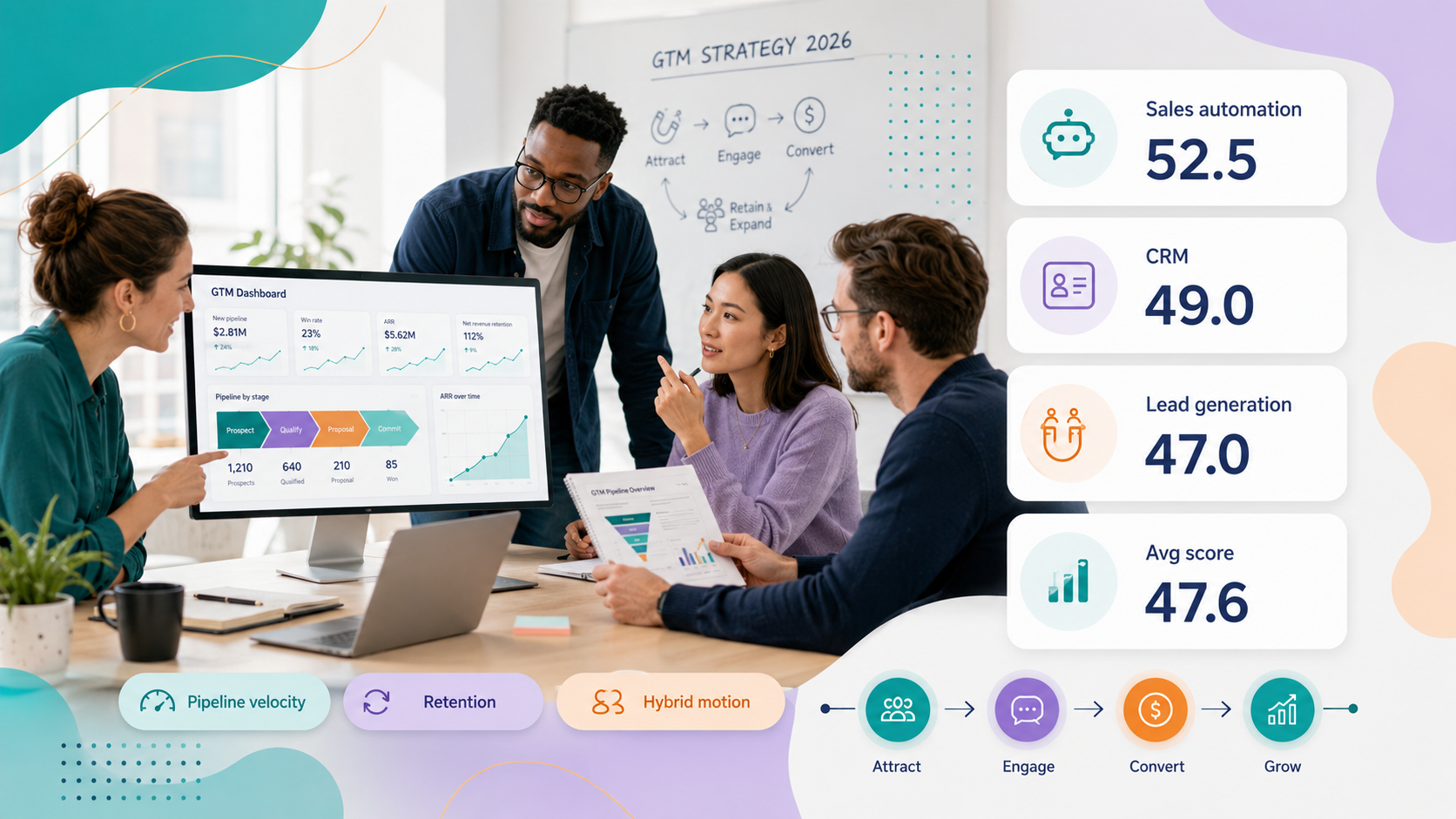
A SaaS go-to-market strategy is the plan for how you reach, win, and keep customers — and the software stack that powers it decides how much of that plan actually compounds into a competitive edge. Most GTM guides stop at the playbook. This one adds the data: which part of your go-to-market motion creates the biggest advantage, and by how much. The clearest finding — sales automation creates the single largest SaaS GTM advantage, scoring 52.5 out of 100, ahead of CRM (49.0) and lead generation (47.0).
Those numbers are Opportunity Scores from the Cllimber Opportunity Index 2026, a dataset of 378 scored industry-and-tool combinations across 63 industries. A SaaS GTM stack spans six software categories, and SaaS records an average Opportunity Score of 47.6 across them — a profile typical of considered, relationship-led B2B selling, where structured pipeline and lifecycle tooling compound in value.
This guide works through all six GTM software categories in order of advantage for SaaS, so you can see where to invest first as you build your stack — and why the answer is specific to how SaaS actually wins and keeps customers.
Each GTM software category gets an Opportunity Score out of 100. Put simply: the higher the score, the bigger the edge you get over rival SaaS companies that don't run that part of their stack well — and the harder it is for them to catch up. It's not about how popular or expensive a tool is. It's about how much ground you gain by getting it right, and how much you lose by ignoring it.
For SaaS companies, GTM advantage concentrates in the tools that convert and retain customers across a recurring-revenue lifecycle. Sales automation, CRM, and lead generation lead because SaaS is a considered, expansion-driven sale where pipeline velocity and lifecycle management compound.
- Sales automation (52.5) is the highest-opportunity GTM category — pipeline velocity is the SaaS growth engine.
- CRM (49.0) sits in the compounding-edge band: lifecycle data drives retention, expansion, and net revenue retention.
- Lead generation (47.0) feeds the pipeline that sales automation converts.
- SaaS averages 47.6 across the six categories — a structured, B2B-style GTM profile.
What is a SaaS go-to-market strategy?
Unlike a one-off launch plan, a SaaS GTM strategy is continuous. Because SaaS revenue is recurring, the strategy has to win the first sale and drive the retention and expansion that make the unit economics work. The strongest strategies treat acquisition, conversion, and retention as one connected motion rather than separate teams — and they choose a software stack that lets data flow across all three.
The components of a SaaS GTM strategy
A complete SaaS go-to-market strategy has five moving parts. Get these right before you worry about individual tools — the stack exists to execute the strategy, not the other way round.
1. Ideal customer profile (ICP) and target market
Define the specific type of company and buyer you serve best — by size, industry, role, and the problem you solve for them. A sharp ICP makes every later decision easier, because messaging, channels, and pricing all flow from who you're selling to. Vague targeting is the most common reason SaaS GTM underperforms.
2. Positioning and messaging
How you frame the product against alternatives — including the status quo of doing nothing. Strong positioning answers "why you, why now" in terms the buyer already cares about, and it's what makes the rest of the funnel convert.
3. Pricing and packaging
How you charge (per seat, usage, tiered, freemium) and how you bundle value into plans. Pricing is a GTM lever, not just a finance decision: it shapes who buys, how fast they expand, and how predictable your revenue becomes.
4. Sales motion and channels
The path from interest to purchase — product-led, sales-led, or a hybrid — and the channels you use to reach buyers (inbound, outbound, partnerships, marketplaces). The right motion depends on your price point and buyer: low-cost, high-volume products lean product-led; higher-priced, multi-stakeholder deals lean sales-led.
5. The GTM software stack
The tools that execute all of the above — sales automation, CRM, lead generation, marketing, SEO, and social. This is where most "GTM strategy" advice goes quiet, because there's little hard data on which categories actually create advantage. That's the gap the section below fills, using scored data from the Cllimber Opportunity Index.
Product-led vs sales-led GTM: which motion fits?
The biggest strategic fork in SaaS go-to-market is your sales motion. It determines how your funnel is built, who you hire, and — crucially — how your GTM software stack should be weighted.
Product-led (PLG)
The product drives acquisition and conversion — free trials, freemium, self-serve signup. Best for lower price points and broad, fast-deciding buyers. Weights the stack toward lead generation, SEO, and product analytics, with sales automation focused on expansion rather than first close.
Sales-led
A sales team drives deals through a considered, multi-stakeholder cycle. Best for higher price points and enterprise buyers. Weights the stack heavily toward sales automation and CRM, because pipeline velocity and relationship management decide who wins.
Most scaling SaaS companies end up hybrid — product-led acquisition feeding a sales-led motion for larger accounts. Whichever you choose, the data below shows sales automation and CRM lead the advantage for SaaS overall, which is why even product-led companies invest in them as they move upmarket.
Which GTM software creates the most advantage for SaaS?
This is where a SaaS go-to-market strategy gets an edge most guides can't give you: hard scores for how much competitive advantage each software category creates. The ranking below is drawn from the Cllimber Opportunity Index 2026, which scores all six GTM categories for SaaS. Use it to decide where to invest first as you build your stack.
How do SaaS companies gain an edge from sales automation?
In plain terms: this is your biggest GTM win. Automated sequencing, lead routing, and pipeline tracking mean deals move faster and nothing stalls — and that velocity advantage compounds into a growth rate rivals can't easily match.
Sales automation is the highest-opportunity GTM category for SaaS, scoring 52.5. SaaS growth is a function of pipeline velocity — how quickly qualified opportunities move to closed-won and then to expansion. Automated outreach, lead scoring, routing, and pipeline management remove the manual drag that lets deals stall, so a SaaS company with a tight sales-automation engine simply converts pipeline faster than a competitor running the same playbook by hand. Because SaaS revenue compounds, a velocity edge held early becomes a growth-rate gap that is very hard to close.
Do SaaS companies need a CRM?
In plain terms: in SaaS the sale doesn't end at signup — it's the start. A CRM that tracks the whole lifecycle is what turns one customer into renewals, upsells and referrals, and that data gets more valuable every year.
Yes — CRM scores 49.0 for SaaS companies, a compounding-edge advantage. SaaS lives on recurring revenue, and the economics are decided after the first sale: retention, expansion, and net revenue retention. A CRM that holds the full customer lifecycle — usage signals, renewal dates, expansion history, support context — lets a SaaS company act on churn risk and upsell signals before a competitor even sees them. The advantage widens with time, because the accumulated lifecycle data becomes an asset a newer rival cannot reconstruct. CRM sits just below sales automation because that lifecycle value is realised through the structured follow-up sales automation drives.
How important is lead generation for SaaS growth?
In plain terms: qualified pipeline is usually the one thing capping SaaS growth. Fix lead flow and you remove the ceiling on how fast the sales engine can run.
Lead generation scores 47.0 for SaaS companies. For most SaaS businesses, the supply of qualified pipeline is the hard ceiling on growth — the sales engine can only convert what's fed into it. Tools that capture, score, and route intent (product-led signups, content capture, intent data, outbound enrichment) give a SaaS company a measurable, ongoing edge over one relying on a single channel. The category scores highly because it feeds the sales-automation and CRM engine that converts and retains; lead generation without strong conversion simply leaks.
How much GTM advantage does marketing software give SaaS?
In plain terms: good marketing automation keeps prospects warm across a long, considered buying cycle — but the edge comes from how well you run it, not just owning the tool.
Marketing software scores 46.0 for SaaS companies. SaaS purchases are considered decisions with multiple stakeholders and a long evaluation window, so marketing automation that nurtures prospects, scores engagement, and keeps the category top of mind across that window creates real advantage. The score sits mid-stack because the edge depends heavily on execution quality — segmentation, messaging, timing — rather than adoption alone. The tooling enables the advantage; the GTM team realises it.
Does SEO drive an edge for SaaS companies?
In plain terms: ranking for the problems your product solves brings in buyers already looking for a solution. Slow to build, but it becomes a durable, low-cost pipeline source.
SEO scores 46.0 for SaaS companies. SaaS buyers research extensively before they ever talk to sales, so ranking for the problem your product solves — and for comparison and alternative queries — captures high-intent demand at the moment of evaluation. The advantage is durable: domain authority, comparison content, and integration pages accrue slowly and are correspondingly slow for a competitor to overtake, which makes SEO one of the few GTM channels that gets cheaper per lead over time rather than more expensive.
Is social media worth it for SaaS GTM?
In plain terms: strong for building category awareness and founder/brand presence — but it only pays off with consistency. Best as an amplifier of the channels above, not a substitute.
Social media scores 45.0 for SaaS companies — the lowest of the six GTM categories, though still a real edge. Social and community building suit category creation, founder-led distribution, and staying visible to a B2B audience between buying cycles. It carries the lowest score because its competitive impact depends heavily on consistency and content quality rather than adoption alone — two SaaS companies with the same tools see very different results. It works best as an amplifier of the higher-scoring GTM categories, not a replacement for them.
How to build a SaaS go-to-market strategy in 2026
Put the framework and the data together, and a SaaS GTM strategy comes together in five steps:
- Define your ICP and target market. Name the exact company type, buyer role, and problem you solve. Everything downstream depends on this.
- Choose your sales motion. Product-led, sales-led, or hybrid — driven by your price point and how your buyers make decisions.
- Set pricing and positioning. Package value to match how your ICP buys, and frame it clearly against the alternatives, including doing nothing.
- Build your GTM stack around your highest-advantage category. For SaaS, that's sales automation (52.5), then CRM (49.0) and lead generation (47.0). Invest there first, then layer in marketing, SEO, and social.
- Measure and compound. Track pipeline velocity, conversion, retention, and net revenue retention — and feed what you learn back into ICP and motion. SaaS GTM is a loop, not a launch.
How a B2B SaaS go-to-market strategy differs
A B2B SaaS go-to-market strategy carries the same five components, but the weighting shifts. B2B deals involve multiple stakeholders, longer evaluation cycles, and higher contract values, which pushes most B2B SaaS companies toward a sales-led or hybrid motion rather than pure self-serve.
That motion makes the top two GTM categories even more decisive. Sales automation (52.5) manages the longer, multi-touch pipeline that B2B deals require, and CRM (49.0) holds the multi-stakeholder context and post-sale lifecycle that drive expansion and net revenue retention — the metrics B2B SaaS lives or dies on. Lead generation and SEO still matter for filling the funnel, but for B2B they feed a sales-led close rather than a self-serve signup. In short: the higher your contract value and the more stakeholders involved, the more your strategy should concentrate on the structured pipeline and relationship tooling at the top of the ranking above.
Your GTM stack is also your buyers' stack — know the industries you sell into
The GTM categories you invest in are the same categories your customers buy. If you sell sales, CRM, lead-gen, SEO, marketing, or social tooling, the Cllimber Opportunity Index shows exactly which industries gain the most competitive advantage from your category — which is where your highest-intent demand sits.
Cllimber publishes an independent, scored software directory for ten of those industries — accountants, law firms, real estate agents, recruitment, ecommerce, marketing agencies, construction, mortgage brokers, insurance, and financial services — where buyers find tools matched to how their industry actually operates.
Build your GTM stack around your highest-opportunity category — and target the industries where that category creates the most advantage.
Frequently asked questions about SaaS go-to-market strategy.
What is a SaaS go-to-market strategy?
A SaaS go-to-market strategy is the plan for how a software company reaches its target customers, wins them, and grows their value over time. It defines who you sell to, how you reach them, how you price and package, which sales motion you use, and which software powers each step. Because SaaS revenue is recurring, it must drive both the first sale and the retention and expansion that follow.
What are the components of a SaaS GTM strategy?
Five components: the ICP and target market; positioning and messaging; pricing and packaging; the sales motion and channels (product-led, sales-led, or hybrid); and the GTM software stack that executes them across sales automation, CRM, lead generation, marketing, SEO, and social.
Product-led vs sales-led GTM — which should SaaS use?
Product-led suits lower price points and fast-deciding buyers and weights the stack toward lead generation and SEO; sales-led suits higher price points and enterprise buyers and weights it toward sales automation and CRM. Most scaling SaaS companies become hybrid — product-led acquisition feeding a sales-led motion for larger accounts.
How do you build a SaaS go-to-market strategy?
Define your ICP; choose your sales motion; set pricing and positioning; build your stack around your highest-advantage category (sales automation 52.5, then CRM 49.0 and lead generation 47.0); then measure pipeline velocity, conversion, retention, and net revenue retention and feed the results back in.
What GTM software gives SaaS companies the biggest competitive advantage in 2026?
Sales automation gives SaaS companies the largest go-to-market advantage of any category, scoring 52.5 out of 100 on the Cllimber Opportunity Index, with CRM (49.0) and lead generation (47.0) next. SaaS averages 47.6 across the six GTM categories.
What does a SaaS go-to-market (GTM) stack include?
A SaaS GTM stack spans six software categories: sales automation, CRM, lead generation, marketing, SEO, and social media. For SaaS the order of advantage runs sales automation (52.5), CRM (49.0), lead generation (47.0), marketing (46.0), SEO (46.0), then social media (45.0).
Do SaaS companies need a CRM?
Yes. CRM scores 49.0 for SaaS, in the compounding-edge band. SaaS runs on recurring revenue and expansion, so a CRM that tracks the full customer lifecycle converts directly into retention, upsell, and referral — and the advantage grows the longer it is maintained.
How important is lead generation for SaaS growth?
Lead generation scores 47.0. Qualified pipeline is usually the main constraint on SaaS growth, so tools that capture and qualify intent feed the sales-automation engine that converts it.
What is the Cllimber Opportunity Index?
The Cllimber Opportunity Index is a proprietary annual dataset scoring the competitive advantage available to businesses in 63 industries from implementing specific software tools effectively over direct competitors that don't. The 2026 edition covers 378 scored combinations across CRM, marketing, lead generation, SEO, social media, and sales automation.
JA