
18 Software and AI Tools Transforming SaaS Businesses in 2026
 JA
JA
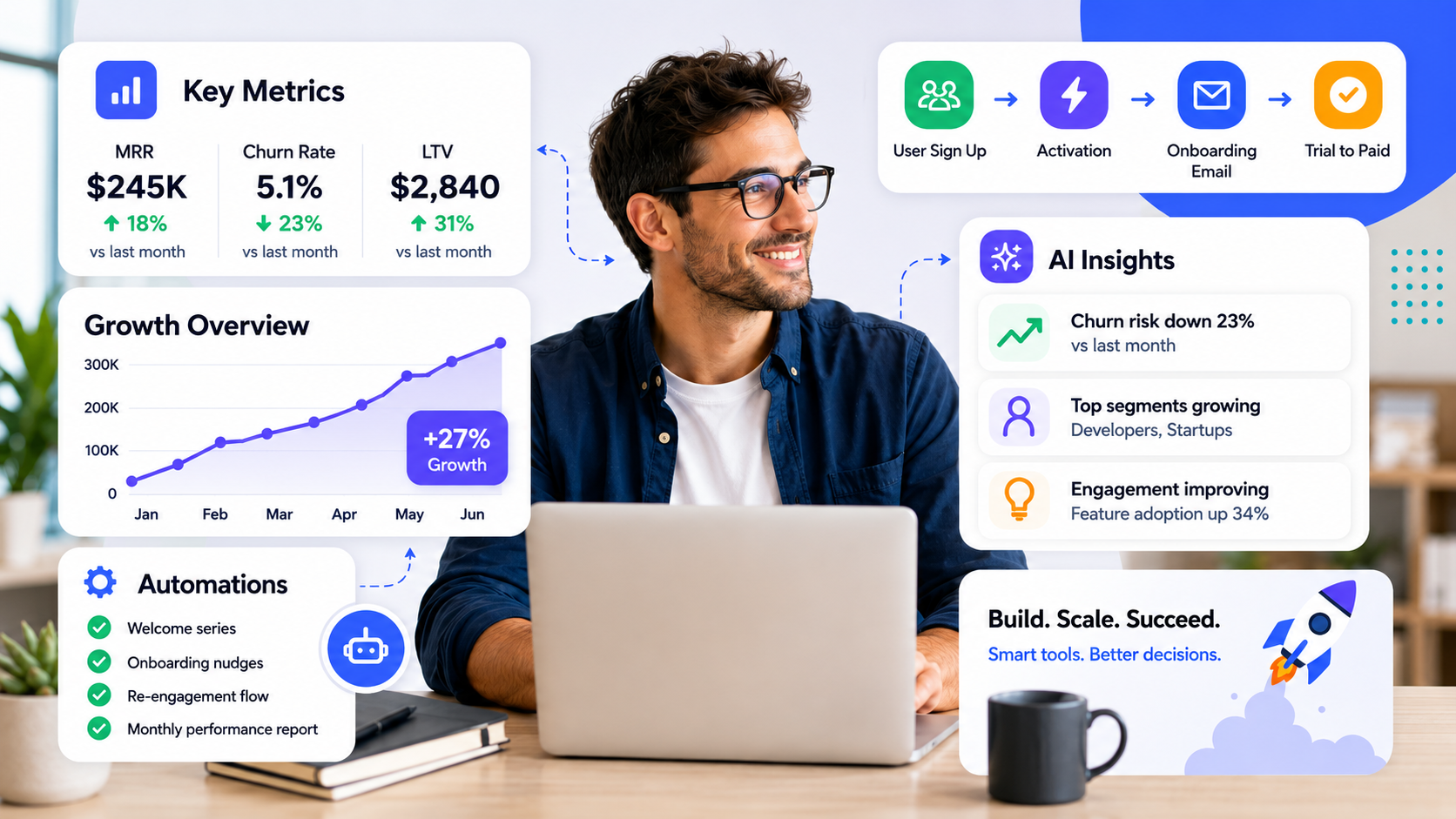
A theme runs through almost every contribution below: in SaaS, the highest-leverage AI is the one closest to revenue and retention, not the one closest to the top of the funnel.
That matches what we see in the data. At Cllimber we track software adoption across 63 industries through the Cllimber Opportunity Index, and SaaS sits in the Professional/B2B archetype, where structured pipeline, CRM, and customer-success tooling compound in value the longer they are held. That is why the 18 practitioner-tested tools and strategies below repay the time to set them up. They come from founders and operators running them in live businesses.
SaaS companies face constant pressure to improve growth, retention, and operational efficiency without expanding headcount. This article presents 18 practical software and AI tools that address these challenges, supported by insights from industry experts who have deployed them in real business contexts. Each tool targets a specific pain point — from referral optimization and churn prediction to content automation and customer health monitoring.
The most effective AI tools for SaaS in 2026 cluster around four jobs: predicting and preventing churn (usage models, customer-health dashboards), compressing the build-and-test loop (Cursor and AI coding tools), event-driven onboarding and lifecycle automation (Intercom, HubSpot), and sharper acquisition through better targeting and content (Clay, AI copy and video). The recurring lesson: apply AI to retention before acquisition, because a few points of retention compound faster than the same gain at the top of the funnel.
- A churn-prediction model cut one company's monthly churn from 8.2% to 5.1% in six months — roughly 37% more lifetime revenue per cohort.
- Event-driven onboarding lifted activation from 34% to 46% and trial-to-paid from 8.5% to 11.2% in about 10 weeks.
- For SaaS, sales automation creates the largest competitive advantage of any software category, scoring 52.5 out of 100 in the Cllimber Opportunity Index 2026, with CRM at 49.0.
- Faster iteration is itself a growth lever — AI coding tools let lean teams collapse build cycles from weeks to days, so they can test more and find what works before runway burns.
Predict Churn and Launch Save Actions
The single tool that moved the needle most for GpuPerHour in the past year is a custom-built usage prediction model that we run on top of our own infrastructure. It is not a third-party SaaS product, which is part of the point: the most impactful AI tool for our business turned out to be one we built ourselves using the same GPU compute we sell.
The model predicts which customers are likely to churn within the next 14 days based on their usage patterns, support ticket history, and billing behavior. It runs daily on a single L4 GPU and processes our entire customer base in about 90 seconds. When the model flags a high-risk customer, it triggers an automated sequence: a personalized email highlighting features they haven't tried, a usage report showing their savings versus on-demand cloud pricing, and a Slack notification to our customer success lead.
The impact on retention has been substantial. Before deploying the model, our monthly churn rate hovered around 8.2 percent. Six months after deployment, it dropped to 5.1 percent. That 3.1-point improvement translates to roughly 37 percent more lifetime revenue per customer cohort. The model cost about $400 in compute to train and runs for under $2 per day in inference costs.
The broader lesson for SaaS operators is that the highest-leverage AI application is almost always the one closest to your revenue. Acquisition tools get more attention, but a 3 percent improvement in retention compounds faster than a 3 percent improvement in top-of-funnel conversion. I'd encourage any founder to look at their churn data before their acquisition data when deciding where to apply AI first.
 FA
FA
Monitor Customer Health to Lift Retention
I run Paperless Pipeline, a real estate transaction management SaaS bootstrapped since 2009. Sixteen years of cash-flow growth and a finite tools budget have taught me that "which one tool moved the needle" is always answered by the tool you actually use every day, not the one with the most exciting features. For us in 2026 the answer is unglamorous: a properly instrumented internal customer-health dashboard built on Looker.
Not a third-party retention product. A dashboard our team built in-house, fed from our own product data, that shows for every brokerage how many transactions they ran last month, how many users logged in this week, how many checklist items closed on time, and how their volume trended over the last six release cycles.
The impact was on the metric that matters most to a bootstrapped SaaS: net revenue retention. Before the dashboard, our customer success team learned about churn risk from a cancellation email. After, they had three to six weeks of warning. Volume drops on a 150-agent brokerage show up in the data before the broker has decided to leave. We get a real call on the calendar, find out what's happening, and either fix it or learn honestly why the customer is leaving.
Net revenue retention moved up about eight points in the first year we ran the dashboard properly. The honest insight is that the tool was less important than the discipline of looking at it every week. Any solid BI tool would have worked. The needle moved because we made the customer-health number the meeting that does not get cancelled.
 DM
DM
Ship Faster with a Smart Editor
The single tool that moved the needle most for us isn't a CRM, isn't an analytics platform, and isn't some enterprise automation suite. It's Cursor, the AI code editor. And it's not even close.
Magic Hour is a two-person company with millions of users. David and I don't have a growth team, a dedicated ops person, or a customer success department. We have AI. And Cursor is the backbone of how we ship at a pace that makes people assume we're a 20-person team.
Before Cursor, building a new feature or running an experiment meant hours writing boilerplate, debugging edge cases, and context-switching between docs. Now I can go from idea to deployed feature in a single sitting. We shipped our entire template system, our onboarding flow revamp, and dozens of acquisition experiments in weeks, not quarters. One specific example: we rebuilt our signup-to-first-video funnel in under three days. That change alone doubled our activation rate.
The compounding effect is what matters. When you can ship faster, you can test faster. When you can test faster, you find what works before your runway burns. Every SaaS metric — acquisition, retention, revenue — improves when your iteration speed goes up 5x or 10x. The founders winning right now are the ones who collapsed their build cycle from weeks to days. The tool that lets you ship faster IS your growth tool, your retention tool, your revenue tool. Everything else is downstream of velocity.
 RL
RL
Use Event Triggers to Onboard
Intercom has had the biggest effect — not because of chat, but because of how it changes onboarding. On one SaaS product with about 1,800 new sign-ups a month, behaviour-based messages were set up around the first three actions that predicted activation. When users stalled, Intercom sent the right prompt or help article based on what they hadn't done yet. Activation rate moved from 34% to 46% over roughly 10 weeks, and trial-to-paid conversion went from 8.5% to 11.2%.
Most teams use it as a support inbox and miss the better use case, which is event-driven onboarding tied to product usage. The useful part is connecting Intercom to product events so messages fire from real behaviour, not time delays. A common mistake is sending the same onboarding sequence to everyone, even though the user who invited a team member on day one needs a different nudge from the user who never finished setup.
I've seen the same pattern in other SaaS businesses: when onboarding is based on actions instead of generic email drips, support tickets drop and retention improves. In one B2B SaaS case, "how do I set this up?" tickets fell by about 28% over two months because the guidance showed up inside the product at the point of friction, not three emails earlier.
 JR
JR
Turn QR Utility into an Acquisition Engine
At Free QR Code AI, the single tool that's moved the needle most for us has been our own AI-powered QR code generation platform — and I know that sounds self-promotional, but let me explain why it matters for our growth story.
When we built freeqrcode.ai, we originally created it as an internal tool to track campaign performance. What happened was unexpected: our QR codes were being scanned at rates 3x higher than industry averages because our AI optimized the visual design, placement recommendations, and call-to-action integration automatically.
Here's where the real impact hit. Our customer acquisition cost dropped by 62% within six months of launching the free tier. The freemium model brought in 14,000 organic users in Q1 alone — high-intent prospects who already experienced value before ever speaking to sales. For retention, the dynamic QR code feature let customers update destinations without reprinting materials, so they stayed subscribed month after month. Net revenue retention climbed to 118%. We also integrated QR codes into our signup flow, dropping time-to-value from 3 days to under 45 minutes and cutting onboarding support tickets by 71%.
If I had to point to one number, it's this: our free-to-paid conversion sits at 8.4%, roughly double the SaaS industry average. That's directly attributable to the QR code tool serving as both our product and our top-of-funnel acquisition channel. We built something useful, gave it away, and let the product sell itself.
 MB
MB
Cluster Open Feedback for Cohorts
The AI tool that's transformed our SaaS marketing ops at Smarfle most measurably in 2026 is the segmentation layer we built on top of our CRM that uses an LLM to read open-ended customer survey responses and cluster them into actionable cohorts every Monday morning. Before, we had quarterly survey analyses produced by a contractor that took six weeks per round and showed up after the insights had stopped mattering. Now we have weekly cohort updates the team can act on within days.
The metric that moved most was time-to-experiment-from-signal. We used to identify a cohort behavior pattern in a survey, then spend three weeks designing and launching an experiment. The compressed timeline is now under a week, which means we run about 3x the experiments per quarter. Not every experiment wins, but the cadence has shifted the team's culture from "we should test that someday" to "we tested that last week."
The metric I'd warn other SaaS marketers against over-optimizing is raw output volume of AI-generated content. We measured it for a quarter and found volume went up 4x but the share of content that produced meaningful pipeline didn't change. The transformative use of AI in SaaS marketing isn't producing more of what you were already making — it's compressing the loop between observation and action so the team learns faster.
 NL
NL
Anticipate Social Wins Pre-Publish
The tool that has moved the needle most for me is InfluenceAI — full disclosure: I'm the founder, and my own Instagram account is the first real test case while we onboard early users.
What makes it different from stitching together ManyChat, Later, and Hootsuite is that it unifies everything under one AI layer: welcome DMs to new followers with AI that continues the conversation until your goal is reached; comment-to-DM and story-to-DM automation with AI follow-up; auto-publishing at the best times for your audience; growth-focused analytics; predictive AI that forecasts how a post will perform before you publish; and an AI Lead Finder that surfaces real Instagram accounts worth reaching out to.
Concrete result on my own account: content planning time dropped from ~8 hours/week to under 30 minutes, and predictive scoring helped identify which Reels were worth boosting before spending on ads — improving reach-per-post by a meaningful margin in the first 14 days.
For SaaS operators and small business owners, the predictive layer is the part worth testing. Most social tools are reactive — they show you what already happened. Predictive AI lets you allocate creative effort and ad spend before publishing, which is where the real ROI compounds.
 CP
CP
Automate Short-Form Copy for Speed
For us it was adopting a dedicated AI copywriting tool for all our short-form marketing copy — ads, email subject lines, product descriptions, and landing page sections. Before that, writing copy was the bottleneck: every campaign waited on someone to draft and rewrite.
Moving that into a tool that generates several on-brand variations in seconds cut our content turnaround from days to minutes and let a tiny team ship like a much larger one. The needle-mover wasn't the AI itself, it was removing the blank-page step so we could test more angles. My one piece of advice: pick a tool built specifically for marketing copy rather than a general chatbot, because structure and conversion patterns matter more than raw text generation.
 EB
EB
Embed Calculators to Remove Friction
As the founder of Calcxi.com, the single category of AI tool that has moved the needle most for our SaaS business in 2026 is AI-powered utility automation — specifically, tools that turn complex, time-consuming calculations into instant, self-serve experiences for users.
At Calcxi, we built our entire platform around this principle. SaaS businesses waste enormous time answering repetitive "how much will this cost me?" or "what's my ROI?" questions. By embedding AI-powered calculators directly into the user journey, we eliminated that friction entirely. The result? Higher engagement, longer session times, and significantly better conversion because users get value before they ever speak to a salesperson.
In 2026, the SaaS tools winning are not the ones adding more features; they are the ones removing decisions from the user's path. AI-driven utility tools do exactly that. If your SaaS product still makes users calculate, estimate, or guess on their own, that is your biggest untapped growth lever.
 AK
AK
Target the Right Accounts Through Context
The tool that has moved the needle most for us is Clay, especially for SaaS customer acquisition. The biggest problem in B2B SaaS is not always finding more leads. It is finding the right accounts, understanding why they are relevant, and reaching out with context instead of generic automation.
We use Clay to enrich prospect data, identify buying signals, segment accounts, and create more personalized outreach workflows. The impact is mainly on pipeline quality: fewer wasted conversations, better reply rates, and more qualified demos from the same prospecting effort.
The key is not using AI to send more noise. It is using AI to make targeting sharper and outreach more relevant. That is where the real SaaS growth benefit is.
 DL
DL
Filter Bot Noise Before Strategy Shifts
When you scale a SaaS product, you tend to think the most important tools are in the acquisition workflow. But the category that ends up being highly critical for retention and revenue protection in 2026 is advanced AI social analytics and bot-detection software like Cyabra or PeakMetrics.
The fastest way to damage your genuine customers is to make product, pricing, or branding decisions based on manufactured outrage. Traditional social listening tools that simply track volume and sentiment are dangerous and antiquated because they cannot separate real user reaction from algorithmic manipulation.
A recent example from a legacy brand's visual refresh shows the risk: an immediate social backlash caused the brand to cave and roll back the initiative. Their stock dropped 10.5%, evaporating ~$100 million in market cap over a few days. But the analytics firm PeakMetrics later found that 44.5% of the posts in the first 24 hours were from bots, and among profiles calling for a boycott, almost half — 49% — were fake, with identical duplicate messaging trying to hijack the discussion.
For SaaS ops performing UI overhauls or new monetization experiments, this is critical learning. If you let an artificial segment of outrage dictate your product strategy, you alienate your real customer base and train the systems that these outrage campaigns work. Instead, integrate bot-detection analytics into your product and growth strategy: detect sudden duplicate messaging and network connections between accounts, dismiss the algorithmic noise, figure out what's real, and move forward based on that.
 CC
CC
Adopt Loom to Explain Setup Clearly
The single tool that made a clear impact was Loom. Onboarding in this space involves detailed operational and financial steps, so written guides alone were not enough. Short recorded walkthroughs helped explain decisions in context and answered common questions early. New users could revisit the same resource anytime without waiting for a live session.
This change reduced repeated back-and-forth during onboarding and made the process smoother. Implementation time became shorter and early product use improved. It also created better alignment across teams, since sales, success, and implementation shared the same explanation. For a lean SaaS team, speed is important but clear communication matters more, and Loom supported both without adding extra steps.
 KB
KB
Clarify Attribution and Qualify Real Demand
The single tool that improved customer acquisition most was an AI-assisted attribution and intent analysis layer. Its value came from clarity rather than lead volume. It helped separate curiosity from purchase readiness by comparing engagement depth, timing, decision path, and fit signals across the funnel. This reduced rewards for activity that looked busy but produced weak revenue outcomes.
Fleet managers and SaaS operators face a similar problem where noise is mistaken for progress. The tool provided a more accountable view of where demand was real and where it was inflated by weak assumptions. This improved pipeline quality and strengthened alignment between marketing and sales teams. Better acquisition came from improved judgment rather than more automation.
 EI
EI
Solve Admin Tasks via ChatGPT
It may sound cliché, but the answer is ChatGPT. Yes, we might all use Claude, v0, or GitHub Copilot to help write code and handle technical tasks — but when it comes to administrative tasks like customer acquisition, retention, and onboarding, ChatGPT has been fundamental in preparing documents or researching strategies on how to achieve these goals. It is hands down the go-to resource whenever I need to complete an administrative task quickly and effectively.
 BC
BC
Accelerate Long-Form Guides on a Lean Team
The single tool that moved the needle most for us this year has been Claude by Anthropic. I run TrulyCritic.com, an independent SaaS review platform where we publish long-form comparison guides for software buyers. A typical guide compares five tools across eight scoring criteria and usually runs 15,000+ words. Before using Claude in our workflow, one guide could take 8 to 10 hours between research, outlining, writing, checking vendor claims, and editing. Now the same guide usually takes 2 to 3 hours, and the quality is better because the structure is stronger from the start.
Claude does not replace the editorial part of the work. I still test the tools, make the final calls, check claims, and decide what belongs in the recommendation. But it handles a lot of the heavy lifting: competitive research, organizing feature comparisons, building scoring frameworks, drafting first-pass breakdowns, and helping us spot gaps between vendor positioning and publicly available information.
The biggest impact has been publishing velocity. We went from around 2 guides per month to 7 guides per month without hiring anyone. That jump helped us grow from zero to 72,000 monthly Google Search impressions in about 60 days. We started ranking for long-tail buying-intent searches and began receiving inbound sponsor inquiries by the second month, with no outbound sales. For a bootstrapped, two-person SaaS content business, Claude has been the system that made this pace possible.
 KS
KS
Fix Trial Drop-Off with Clean Handoffs
For me, the single tool that moved the needle most for SaaS growth has been HubSpot, especially when paired with AI-assisted workflows for lead scoring, onboarding emails, renewal alerts, and sales follow-ups. The big gain was not flashy AI — it was getting cleaner handoffs between marketing, sales, customer success, and support.
One workflow that worked really well used behavior-based triggers for trial users. If someone signed up but didn't complete a key setup step, they received a short, specific email based on what they missed. If they viewed pricing twice or invited teammates, the sales team got a prompt to reach out with context. That improved trial-to-demo conversions by around 18% and reduced manual follow-up work by nearly a third.
My advice to SaaS teams is to avoid using AI just to send more messages. Use it to spot intent and make the next touch more relevant. Start with one funnel leak — like trial drop-off or renewal risk — then build the workflow around that. The tool only works when the customer signal is clear.
 VB
VB
Forecast Liquidity Early to Protect Runway
The tool that moved the needle most had nothing to do with acquisition or onboarding. It was an AI-driven cash flow forecasting layer sitting on top of existing ERP data. Not a prettier dashboard — a system that flagged liquidity risk six to eight weeks before standard reporting caught it, with enough lead time to make a decision rather than manage a consequence.
Two potential runway crunches were addressed before either became a board conversation. Average response time to cash stress signals dropped from 23 days to 6. The reason it worked where others had failed was unglamorous: clean, reconciled data underneath it before a single algorithm ran on top. The intelligence only travelled as far as the foundation allowed.
The SaaS tools actually moving metrics in 2026 surface the right signal at the right moment. Everything else is just a faster way to arrive at the same problem too late.
 AS
AS
Spark Quality Referral Growth
The single tool that moved the needle most for us was lifecycle marketing automation — specifically the system we used to segment users and trigger personalized email sequences around referral behavior. The lesson was that the tool itself didn't win because it sent emails faster. It won because it let us react to intent with the right message at the right moment.
We tested this on a referral campaign where the first version was too broad. The offer was understandable but felt transactional: "refer someone and get a reward." So we rebuilt the campaign around behavior-based segments — warm contacts, existing users, and people who had already engaged with relevant content each received different messaging. We paired those sequences with targeted social ads and tested three angles: financial incentive, mutual benefit, and exclusivity.
The exclusivity and community angle performed best. The message changed from "send us a lead" to "invite someone who would genuinely benefit from this." That small copy change shifted the psychology of the campaign — people were more willing to refer when the action felt like a useful introduction, not a sales transaction. The impact was a 45% increase in referral signups, and customer acquisition costs went down compared with colder channels.
My advice to SaaS teams: don't buy automation and immediately build complicated funnels. Start with one revenue moment where timing clearly matters — failed onboarding, inactive trial users, expansion signals, referrals, or demo no-shows — then use automation to personalize the next step based on behavior. The best tool is the one that turns customer intent into action before the moment goes cold.
 NB
NB
What the data shows: for SaaS, the tool category is as important as the tool
Sales automation is the single highest-opportunity category for SaaS, scoring 52.5. It crosses into the structural-advantage tier: structured pipeline and lifecycle management builds a compounding revenue-velocity advantage a competitor cannot quickly replicate — the data behind the retention and lifecycle wins operators report above.
CRM (49.0) and lead generation (47.0) both score in the compounding-edge band. In a recurring-revenue model where retention compounds over the customer lifetime, relationship and pipeline tooling widens the gap the longer it is held — which is why so many contributors point to retention over acquisition.
Every tracked category scores 45.0 or higher for SaaS. As a Professional/B2B archetype, almost any well-executed go-to-market tool produces a compounding edge — so execution quality and the choice of where to apply AI first, not category alone, is usually the deciding factor.
Identify your highest-opportunity category before comparing individual products.
Frequently asked questions about AI tools for SaaS businesses.
What are the best AI tools for SaaS businesses in 2026?
The most effective fall into four groups: churn prediction and customer-health monitoring (usage models, BI dashboards), AI coding tools that speed iteration (Cursor), onboarding and lifecycle automation (Intercom, HubSpot), and acquisition tools for targeting and content (Clay, AI copywriting, Magic Hour video). The strongest results come from applying AI to retention before acquisition.
How can SaaS companies use AI to reduce churn?
By predicting churn before it happens. A usage-prediction model can flag customers likely to leave within two weeks based on usage, support, and billing patterns, then trigger save actions such as personalised emails and customer-success outreach. One company cut monthly churn from 8.2% to 5.1% in six months this way — roughly 37% more lifetime revenue per cohort.
Should SaaS companies use AI for acquisition or retention first?
Retention first. A few points of improved retention compound faster than the same gain in top-of-funnel conversion, because retained revenue recurs across the customer lifetime. Operators repeatedly recommend looking at churn data before acquisition data when deciding where to apply AI, then expanding into onboarding and lead generation once retention is instrumented.
How does AI improve SaaS onboarding and activation?
By making onboarding event-driven rather than time-based. Connecting a tool like Intercom to product events lets messages fire from real behaviour — prompting users at the exact point of friction instead of on a generic email drip. One product moved activation from 34% to 46% and trial-to-paid from 8.5% to 11.2% in about 10 weeks, while setup-related support tickets fell.
Do AI coding tools actually help SaaS growth?
Yes — indirectly but powerfully. AI code editors such as Cursor let small teams collapse build cycles from weeks to days, so they can run more experiments and find what works before runway burns. Because faster iteration improves acquisition, retention, and revenue at once, the tool that lets you ship faster effectively becomes your growth tool.
What is the Cllimber Opportunity Index?
The Cllimber Opportunity Index is a proprietary annual dataset scoring the competitive advantage available to businesses in 63 industries from implementing specific software tools effectively over direct competitors that don't. The 2026 edition covers 378 scored combinations across CRM, marketing, lead generation, SEO, social media, and sales automation.
Which software gives SaaS businesses the biggest competitive advantage?
According to the Cllimber Opportunity Index 2026, sales automation scores highest for SaaS at 52.5, followed by CRM at 49.0 and lead generation at 47.0. As a recurring-revenue Professional/B2B model, SaaS extracts the most durable advantage from structured pipeline, CRM, and lifecycle tooling. Identify the highest-opportunity category for your business before comparing individual products; see the SaaS breakdown on Cllimber.
What SaaS metric should AI tools be measured against?
Measure AI tools against the loop between observation and action, not raw output volume. Operators warn that AI can multiply content or messages 4x without improving pipeline; the transformative effect is compressing the time from signal to experiment so the team learns faster. Net revenue retention, activation, and trial-to-paid conversion are the metrics that reflect this.
JA