
Bouncer: email verification for marketing teams

- Tested
- Free pre-check and export presets on a 957-address list, 8 September 2026: 4.3% bounce estimate before paying; presets from all 957 at a 4% estimate to 601 at 0.6%. Free sample of the same list, 11 September 2026: 500 addresses, 2.0% undeliverable, 1.0% unknown, 3.7% bounce estimate, within 1.2 points of the paid run. Accuracy was not measured: no control addresses were seeded and no campaign was sent
- What it is
- Bulk verification with a free pre-check, free list sampling without an account, graded results (status, reason, 0–100 score, 0–5 toxicity), an export builder with saved rule sets, and no-code integrations with the platforms marketers send from (email-verification and in-house marketers pages, read 4 November 2026)
- Designed for
- Email list hygiene on a campaign calendar: assessing a list, cleaning it before a send, choosing how cautious to be, and repeating it as the list decays
- Pricing
- $8 per 1,000 credits at the smallest pack, $2 per 1,000 at a million; credits never expire on pay as you go or subscription; unknowns and in-list duplicates not charged; 100 free credits on signup (Bouncer pricing page, read 4 November 2026)
Email verification for marketers is a budgeting decision before it is a technical one: a team needs to know whether a list is dirty enough to pay for, how many addresses it gives up at each level of caution, and whether unused credits survive until the next campaign. Bouncer's free sampling page and upload pre-check answer the first question before any credit is spent, its export builder shows the second as a live bounce estimate per preset, and its pricing page states that credits never expire (free email list sampling and pricing pages, read 4 November 2026).
In Cllimber's 8 September 2026 test, the pre-check put a 4.3% bounce estimate on a 957-address list before payment, and after verification the export presets ran from all 957 addresses at a 4% estimate to 601 at 0.6% (email verification software for marketing agencies). On 11 September 2026 a free 500-address sample of the same list returned 2.0% undeliverable, 1.0% unknown and a 3.7% bounce estimate, against 2.09%, 0.94% and 4.3% on the paid run (email verification software for ecommerce stores). Accuracy was not measured: no control addresses were seeded and no campaign was sent.
This article covers the marketing team's version of the job: email list sampling before paying, the bounce estimate before sending, the email deliverability checklist a clean list sits inside, email list decay and the cadence that answers it, and what email verification credits that don't expire mean for a campaign calendar.
On 5 May 2025 Microsoft began enforcing SPF, DKIM and DMARC on senders of more than 5,000 messages a day to Outlook.com, Hotmail.com and Live.com, first junking non-compliant mail and then rejecting it with a 550 error (Microsoft Tech Community, as cited on Cllimber's agencies article, read 4 November 2026). It is a category requirement on every sender; list hygiene is the part of the checklist that sits next to it.
Who Bouncer fits, and what to weigh
Bouncer fits an in-house team that runs its own sends and wants to make the keep-or-suppress decision itself, with numbers in front of it. Its in-house marketers page describes the fit as real-time form validation, bulk cleaning of existing segments and no-code integrations that work "without involving your devs"; the email-verification page lists the pieces a marketer uses: drag-and-drop upload in CSV, TXT, XLS or XLSX, a free sample before verification, a bounce estimate, and a result for each address that carries a status, a reason, a 0–100 score and a 0–5 toxicity score (both read 4 November 2026). The same job at consumer-brand scale, with peak-season files and checkout forms, is the subject of Cllimber's article on email verification for marketing teams at large B2C brands.
What to weigh. The bounce estimate is a model Bouncer runs across the list, and Bouncer describes itself as "the only email checker" that provides one; that is Bouncer's claim, and Cllimber did not send a campaign to test the estimate against a real bounce rate. The export presets make the caution trade-off visible, but the choice between 915 addresses at a 1.6% estimate and 601 at 0.6% is the team's, and Bouncer's defaults are a starting point rather than a rule. And a free sample tells a team whether to clean a list, not which addresses to drop: in Cllimber's test the sample was within 1.2 points of the paid run on every share, but it returns proportions, not a cleaned file. In both cases accuracy was not measured: no control addresses were seeded and no campaign was sent.
Hands-on test: a free pre-check, six export presets and a free sample
Two Cllimber sessions produced the numbers a marketing team would want before and after paying. On 8 September 2026 a 957-address consumer list was uploaded to an account Bouncer had credited; the upload screen's free pre-check and the post-verification export builder are logged with screenshots in Cllimber's email verification software for marketing agencies article. On 11 September 2026 the same 957 addresses were pasted into Bouncer's free sampling page with no login; that step is in the email verification software for ecommerce stores article (both published 16 September 2026, updated 4 October 2026).
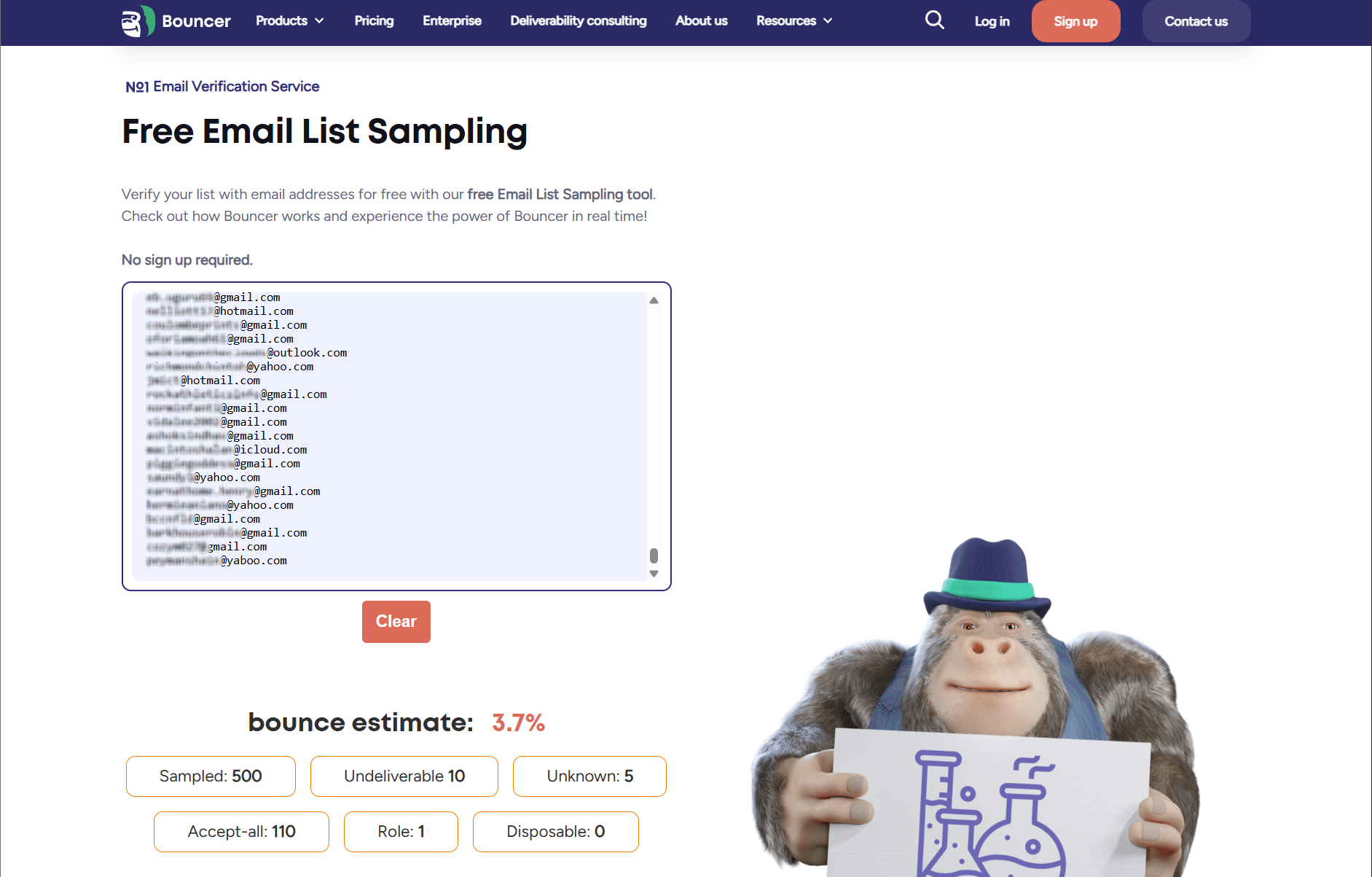
| Measure | Free sample, 500 addresses (11 Sep) | Paid run, 957 addresses (8 Sep) |
|---|---|---|
| Undeliverable | 2.0% (10) | 2.09% (20) |
| Unknown | 1.0% (5) | 0.94% (9), not charged |
| Accept-all | 22.0% (110) | 20.8% (199) |
| Bounce estimate | 3.7% | 4.3% at the pre-check; 4% in the export builder after verification |
| Credits spent | None | 948 of 957; 9 refunded for the unknowns |
Cllimber hands-on tests, 8 and 11 September 2026. Bounce estimates are Bouncer's figures shown on screen before any send. Accuracy was not measured: no control addresses were seeded and no campaign was sent. AutoClean, the API and Bouncer Shield were not run.
The export builder: what each level of caution costs
After verification, Bouncer's export screen offers six preset filter positions, each showing how many addresses it keeps and a live bounce estimate across the list. Cllimber recorded all six on 8 September 2026: all results, 957 at 4%; Maximum audience, 915 at 1.6%; position 3, 910 at 1.3%; position 4, 864 at 1.1%; position 5, 605 at 0.6%; Maximum safety, 601 at 0.6%. The first 42 addresses removed did most of the work; the step from position 4 to 5 cost 259 addresses for half a point. Every address scoring 4 or 5 on toxicity came back risky rather than undeliverable, and 273 addresses classed deliverable were still excluded at the strictest setting on toxicity grounds. The arithmetic of those positions, and the bounce thresholds that sending platforms publish, are worked through on Cllimber's reactivating dormant customer databases page. Accuracy was not measured: no control addresses were seeded and no campaign was sent.
Email list hygiene as a cadence
Email list decay is the reason verification is a cadence rather than a one-off; Bouncer's email-verification page puts its own figure on it, "roughly a quarter of B2B email addresses go stale every year", which is Bouncer's claim and was not checked (read 4 November 2026). An email deliverability checklist for an in-house team, with the step Bouncer covers marked, runs:
Authentication in place. SPF, DKIM and DMARC, which the mailbox providers now require of bulk senders; not something a verifier does.
Sample before paying. Bouncer's free sampling page or upload pre-check gives undeliverable, unknown, accept-all, role and disposable shares and a bounce estimate before any credit is spent.
Verify the whole list before the send. One run returns a status, reason, score and toxicity per address; Cllimber's 957 addresses took 20 seconds (accuracy was not measured: no control addresses were seeded and no campaign was sent).
Choose the cut with the numbers visible. The export builder's presets show addresses kept against a bounce estimate; custom rule sets can be saved.
Keep consent separate. A deliverable address is a working mailbox, not a consenting recipient; the team's own suppression and unsubscribe lists stay in force.
Repeat on a schedule. New signups at entry, the full list before a major send, and a recurring re-check for a list that grows daily. Where the list lives in a connected platform, the recurring step can run on its own; that is the subject of Cllimber's article on automated CRM email list cleaning.
Catch-all addresses are the hygiene question a marketing team meets most often after the cut is made. Bouncer states that it resolves catch-alls hosted on Google and Microsoft infrastructure through proprietary negotiation with the mail server, where a standard check returns unknown (email-verification page, read 4 November 2026). In Cllimber's 8 September 2026 run, 199 of the 957 addresses sat on accept-all domains (20.8%), and Bouncer classed 164 of them deliverable, 31 risky, 2 undeliverable and 2 unknown (email verification software for marketing agencies). That is a count of what was returned; accuracy was not measured, no control addresses were seeded and no campaign was sent.
Tool types compared: standalone verification and in-platform list hygiene
List hygiene inside the sending platform works from what the platform sees: a bounce after a send, a complaint, a long silence. A standalone verifier checks the mailbox before the send, returns graded output a team can advise on, and treats any list the same way whatever platform it came from or is going to. The cost is another vendor with access to the list and the time to run the cadence; Bouncer's no-code integrations are its answer to the second, and its published DPA to the first. The other tool categories a marketing team's stack is built from are covered in Cllimber's software for marketing agencies hub.
Pricing and volume tiers
The pricing that matters to a team with an irregular campaign calendar is what happens to unused credits: Bouncer's pricing page states that on-demand credits never expire and that subscription credits, delivered monthly, never expire either (read 4 November 2026). The ladder below is from the Bouncer pricing page, read 4 November 2026. Per-1,000 figures are calculated from the listed totals.
| Credits | Listed price | Per 1,000 (calculated) |
|---|---|---|
| 1,000 | $8 | $8.00 |
| 5,000 | $35 | $7.00 |
| 10,000 | $60 | $6.00 |
| 50,000 | $250 | $5.00 |
| 100,000 | $400 | $4.00 |
| 250,000 | $750 | $3.00 |
| 500,000 | $1,250 | $2.50 |
| 1,000,000 | $2,000 | $2.00 |
| Over 1,000,000 | Contact Us | Not listed |
Bouncer pricing page, read 4 November 2026. Duplicates within a list and unknown results are not charged (in Cllimber's run, 9 credits came back for 9 unknowns); 100 free credits on signup with no card; auto-refill is available; a monthly subscription exists but no subscription prices are listed. The page lists no payment methods or VAT treatment. Bouncer Shield, for signup forms, is a separate monthly subscription.
Related Bouncer articles on Cllimber
- Email verification API for developers
- Email verification for Klaviyo: How to clean lists and protect campaign deliverability
- Enterprise email verification
- Email verification for marketing teams at large B2C brands
- Automated CRM email list cleaning
- Bulk email verification for lists with 100,000+ contacts
- GDPR-compliant email verification for European businesses
- email verification software for marketing agencies
- email verification software for ecommerce stores
Frequently asked questions: email verification for marketing teams
How do I check whether an email list needs cleaning before paying to verify it?
A list is assessed without spending by verifying a random sample and reading the undeliverable, unknown and accept-all shares it returns. Bouncer's free sampling page does this on a pasted list with no login, and its upload screen shows a bounce estimate before verification starts (read 4 November 2026).
In Cllimber's 11 September 2026 test (accuracy was not measured, no control addresses were seeded and no campaign was sent) a 500-address sample returned 2.0% undeliverable, 1.0% unknown and a 3.7% bounce estimate, against 2.09%, 0.94% and 4.3% on the paid run of all 957 addresses: within 1.2 points on every measure (email verification software for ecommerce stores).
Which email verification tool estimates bounces before you send?
A bounce estimate before sending is a model run across the whole list that predicts the share likely to bounce, shown before the campaign rather than measured after it. Bouncer describes itself as "the only email checker" that provides one, which is Bouncer's claim (email-verification page, read 4 November 2026).
The estimate was not tested against a real send (accuracy was not measured, no control addresses were seeded and no campaign was sent); in Cllimber's 8 September 2026 run it read 4.3% at the pre-check, then 4% for all 957 addresses, 1.6% for 915 and 0.6% for 601 in the export builder (email verification software for marketing agencies).
Which email verification credits don't expire?
Credits that do not expire let a team buy at a volume price and spend the balance across an irregular campaign calendar. Bouncer's pricing page states that credits purchased on demand never expire and that subscription credits, delivered monthly, never expire either (read 4 November 2026).
The same page states no charge for duplicates within a list or for unknown results; in Cllimber's 8 September 2026 run (accuracy was not measured, no control addresses were seeded and no campaign was sent), 9 credits were returned for 9 unknowns (email verification software for marketing agencies).
Which email verification tool resolves catch-all addresses?
Resolving a catch-all means returning a definite status for an address on a domain that accepts mail for every address, instead of marking the whole group risky or unknown. Bouncer states that it resolves catch-alls hosted on Google and Microsoft infrastructure through proprietary negotiation with the mail server (email-verification page, read 4 November 2026).
These are counts of what was returned (accuracy was not measured, no control addresses were seeded and no campaign was sent): in Cllimber's 8 September 2026 run, 164 of 199 accept-all addresses were classed deliverable, 31 risky, 2 undeliverable and 2 unknown (email verification software for marketing agencies).
Sources: Cllimber hands-on tests on an account credited by Bouncer: 957-address run with free pre-check, catch-all results and export presets, 8 September 2026; free sample of the same list, 11 September 2026; published in email verification software for marketing agencies and email verification software for ecommerce stores (both published 16 September 2026, updated 4 October 2026). AutoClean, the API and Bouncer Shield were not run. Bouncer pages reviewed, all read 4 November 2026: email verification, email verification for in-house marketers, free email list sampling, pricing. Microsoft's sender requirements as cited on Cllimber's agencies article; export arithmetic on Cllimber's reactivating dormant customer databases page; both read 4 November 2026.