
Bouncer: email verification software for ecommerce stores

- Tested
- 957-address consumer list, 8 September 2026: results in 20 seconds; 874 deliverable, 54 risky, 20 undeliverable, 9 unknown and uncharged; 164 of 199 catch-all addresses classified deliverable. Classification accuracy and campaign bounce rates were not measured
- What it is
- Bulk verification, Email Verification API, Bouncer Shield for forms, AutoClean for connected platforms, Toxicity Check
- AutoClean runs on
- HubSpot, User.com, Klaviyo, Brevo, Mailchimp and Inboxroad
- Designed for
- Signup and checkout protection, cleaning a database before a campaign, reactivating dormant customers, keeping a connected list clean on a schedule
- Built for
- Stores handling customer data under GDPR: processing on AWS Frankfurt, a published DPA, 60-day deletion
- How it works
- Upload a CSV, import a list from a connected platform such as Klaviyo, call the API, or paste the Shield script into a form. One credit per address
- Pricing
- $8 per 1,000 credits, falling to $2 at a million; credits never expire, duplicates and unknown results not charged. Bouncer Shield is a separate monthly subscription from $2 for 1,000 checks
- Main consideration
- No one-click store install; Bouncer Shield is a separate subscription from verification credits
Target market: ecommerce stores that depend on lifecycle email
Bouncer fits ecommerce stores whose revenue depends on lifecycle email marketing: abandoned cart, post-purchase, win-back and the seasonal sends that mail the whole customer history at once. A bounce on those flows is a message that never reached a customer, and abandoned cart email deliverability is the first place a dirty list shows. Verification runs at the form, in bulk and on a schedule inside the sending platform, from one account; the trade-off is the connection, which is a platform integration, the API or an automation platform rather than a store app.
| Stage | Bouncer feature | Ecommerce use |
|---|---|---|
| At signup or entry | Bouncer Shield or the Email Verification API | Identify typos, disposable and invalid addresses before they enter the database |
| Before a campaign | Bulk verification or a platform integration | Check existing contacts and segment the results |
| Ongoing | AutoClean, on HubSpot, User.com, Klaviyo, Brevo, Mailchimp or Inboxroad | Verify new contacts as they arrive and periodically recheck existing ones |
The three stages as Bouncer frames them; the features are Bouncer's, the ecommerce use is ours.
Distinguishing features: graded results and a cautious classifier
Bouncer grades every address rather than returning valid or invalid: each comes back with a status, a reason, a 0–100 score and a separate 0–5 toxicity score. The classifier errs on the side of the customer: where it cannot be sure, Bouncer returns unknown rather than undeliverable and refunds the credit, as set out on its Bouncer Guarantee page. For a store the practical meaning is that a paying customer with a slow mail server is not silently dropped from the list. The cost of that caution is a handful of unknowns the store has to re-check itself, and Shield being billed separately from credits.
Deliverability requirements: list hygiene is now a sending condition for stores
Email list hygiene for ecommerce is now a sending requirement rather than housekeeping: Gmail holds bulk senders to a spam-rate ceiling, and a growing share of a store's customer file arrives online as an email address. Two official figures set out the scale.
Email verification for ecommerce: one mailbox check, run at entry, in the database and over time
Email verification establishes whether an address can receive mail, without sending any: the syntax is valid, the domain exists, it has a mail server, and that server will accept delivery to the mailbox. A store needs the answer at entry, in the database and over time; ecommerce email validation at the form and ecommerce email list cleaning in the database are the same check run at different moments. Bouncer returns a status (deliverable, risky, undeliverable, unknown), a reason code, a 0–100 score, a 0–5 toxicity score and, for a typo, a suggested correction.
What should a store do with each verification result?
Two layers. The status is what Bouncer found; the keep / suppress / quarantine label is what Bouncer Recommends suggests doing about it, on thresholds the store sets. The right-hand column is how stores commonly act on each status, not a Bouncer rule.
| Status | What it means | Common handling |
|---|---|---|
| deliverable | A mailbox that exists and accepts mail. Not evidence that the customer consented or will open anything | Keep, and apply the store's own consent and suppression lists as usual |
| risky | An accept-all domain, a full mailbox or a disposable address: mail might bounce, or land and never be read | Act on the label. Bouncer's defaults put disposable and toxic addresses in suppress; accept-all and full mailbox go to quarantine |
| undeliverable | No such address or domain, or the server refused it | Hold back from every send; keep the customer record where there is an order history |
| unknown | The receiving server did not respond within the check. No credit charged | Leave it in place and run it through a bulk check later |
Definitions from Bouncer's Klaviyo integration guide and API documentation, read 11 September 2026. Bouncer Recommends defaults: keep for safe addresses; suppress for undeliverable, toxic and disposable; quarantine for the rest. All three thresholds can be changed.
Hands-on test results: 957 consumer addresses verified in 20 seconds
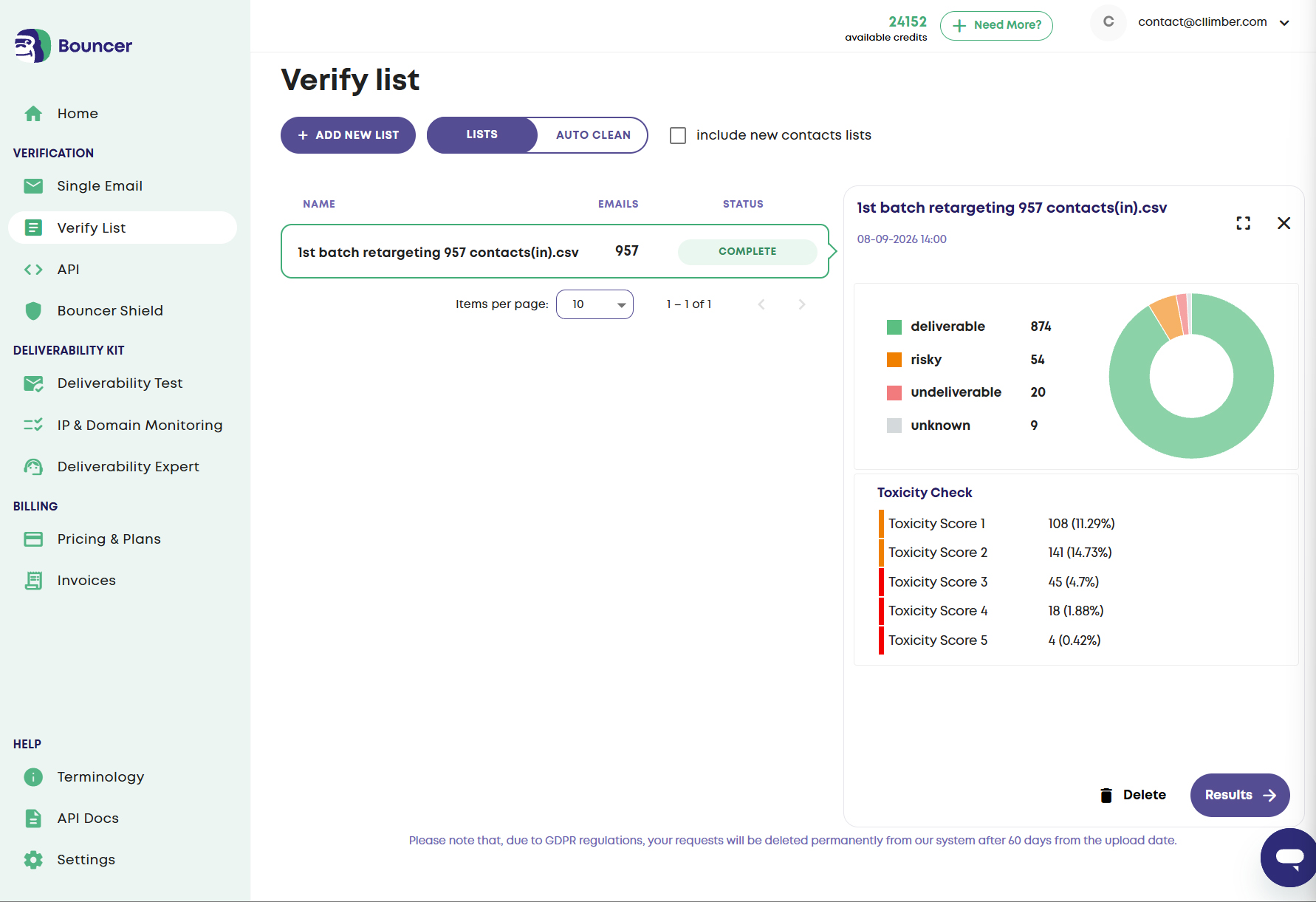
On 8 September 2026 Bouncer returned results for a 957-address consumer list in 20 seconds: 874 deliverable, 54 risky, 20 undeliverable and 9 unknown, with the nine unknown credits refunded and 164 of 199 catch-all addresses classified deliverable.
The run used an account the company had credited with 25,000 credits; on 11 September we ran four single checks and a free sample, each step logged with times and a screenshot. The list was 96.2% free-provider addresses across 62 domains: a store's newsletter file, not a B2B database.
Open Data: The complete raw export of this benchmark test—including all status classifications, toxicity scores, and catch-all resolutions—is published openly for independent analysis. You can access and fork the full dataset on Kaggle: Bouncer Email Verification Benchmark (Ecommerce & Agencies).
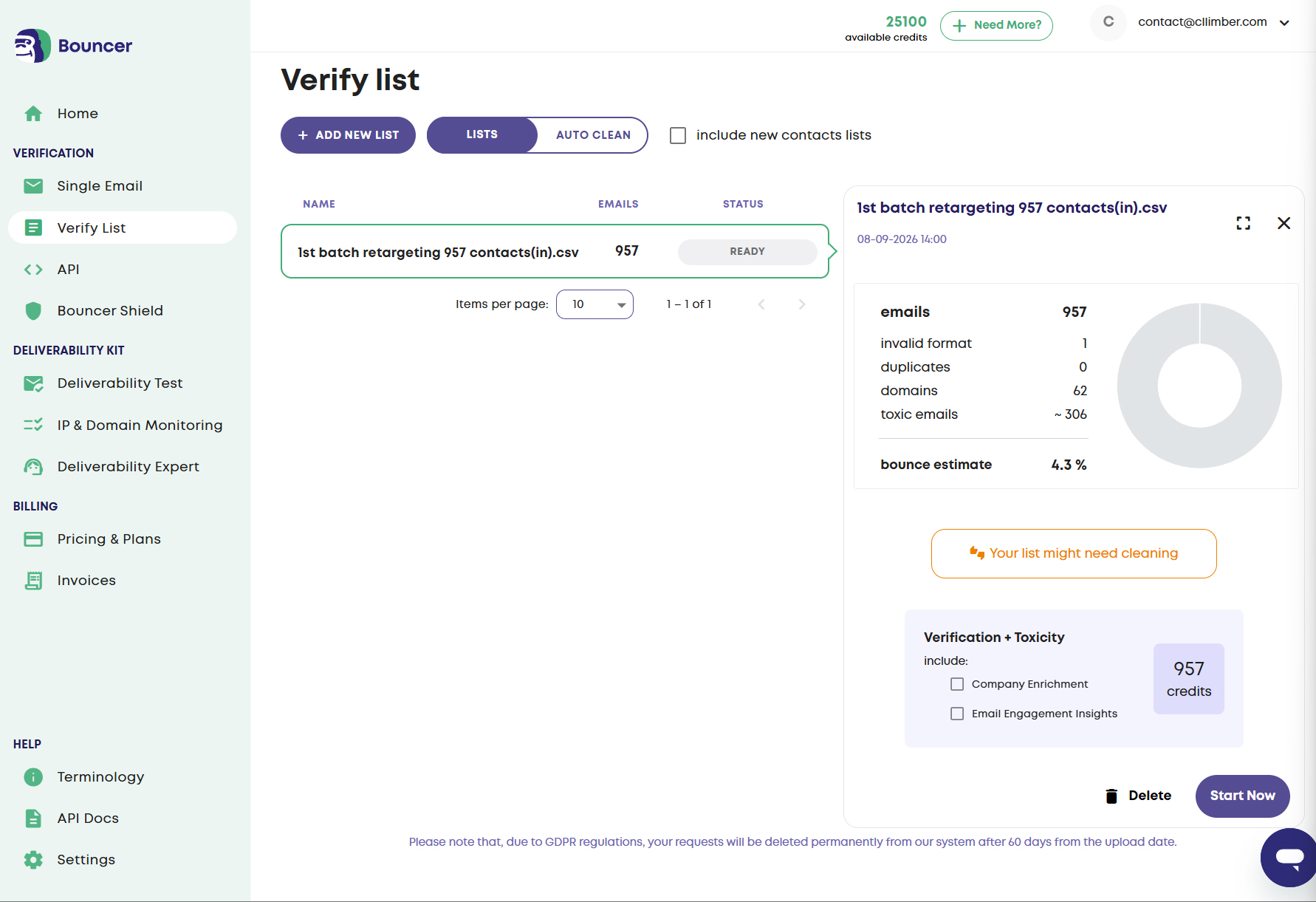
The free pre-check before any credit was spent: 957 addresses, one invalid format, no duplicates, 4.3% bounce estimate.
| What came back | Result |
|---|---|
| Upload to results, 957 addresses | 20 seconds, stopwatch |
| deliverable | 874 (91.3%) |
| risky | 54 (5.6%) |
| undeliverable | 20 (2.09%) |
| unknown | 9 (0.94%) |
| Catch-all addresses | 199 (20.8%), of which 164 came back deliverable |
| Credits charged | 948 of 957; nine refunded, matching the nine unknowns |
Cllimber hands-on test, 8 September 2026. Bouncer publishes 98% coverage and this run beat it. We did not measure accuracy: no control addresses were seeded and nothing was sent to the list afterwards.
Checkout email validation: four in-app single checks
These were in-app tests, not checks on a live form. The app's single-email check uses the same engine as the API and Bouncer Shield; on 11 September we ran the four address types a store's form typically meets.
| Address | Status and reason | What Bouncer returned |
|---|---|---|
| test.order@gnail.com (typo) | risky · low quality | Score 10, toxicity 4, and a prompt: "Did you mean test.order@gmail.com?" |
| test.order@mailinator.com (disposable) | risky · low quality | Disposable: yes. Score 10, toxicity 3 |
| info@cllimber.com (role) | undeliverable · rejected email | Role: yes. The mailbox does not exist |
| A real customer's Gmail address (redacted) | deliverable · accepted email | Free provider, score 100, toxicity 0 |
Cllimber in-app test, 11 September 2026. Each check returned in a few seconds and cost one credit; a repeat of the real address was charged again, so the no-duplicates rule applies within a list only.

The free sample against the paid run
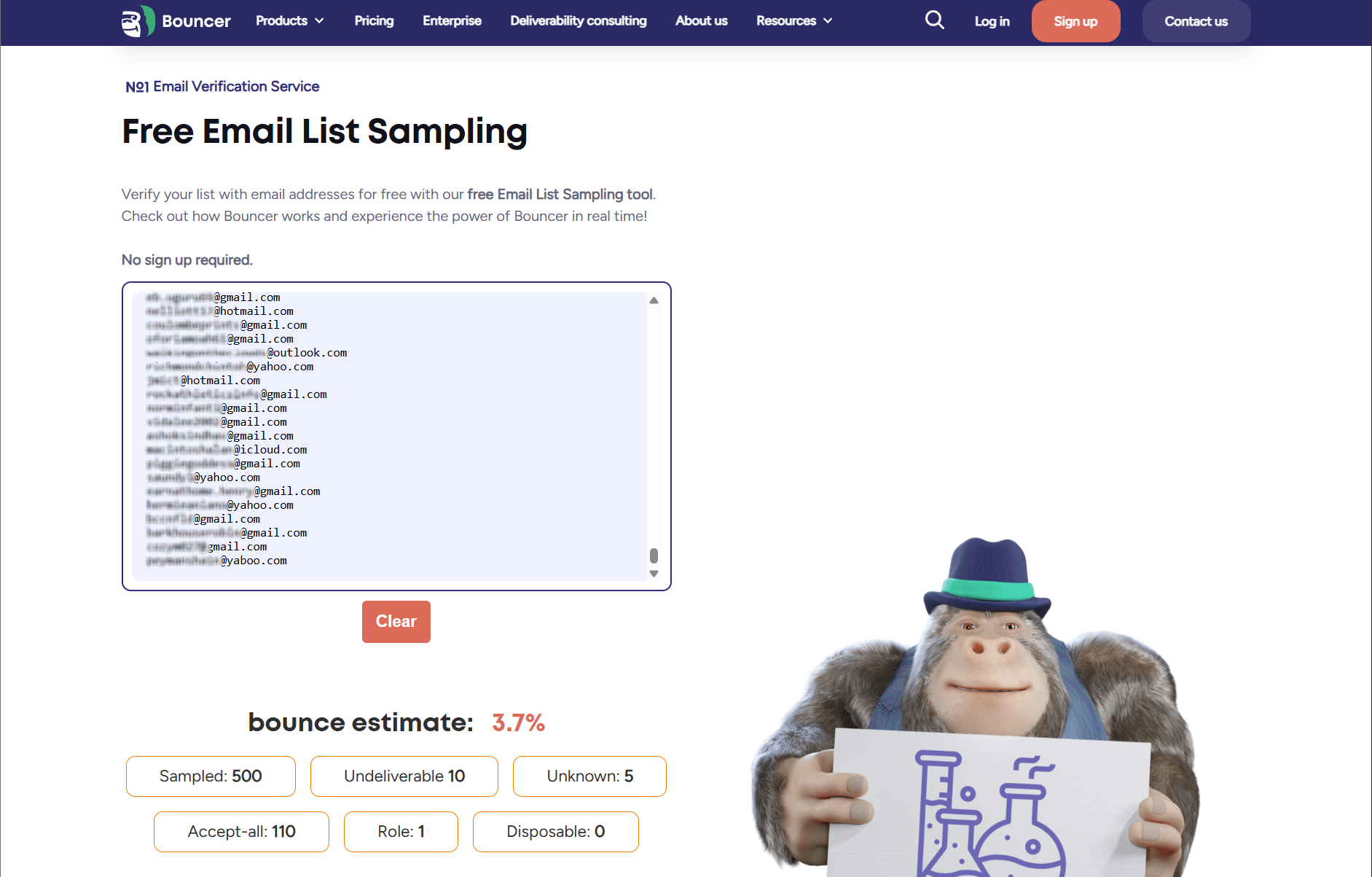
Bouncer's free list sampling page verifies a random sample of a pasted list, no login. On 11 September we pasted the same 957 addresses; it sampled 500 and returned 2.0% undeliverable, 1.0% unknown, 22.0% accept-all and a 3.7% bounce estimate, against 2.09%, 0.94%, 20.8% and 4.3% on the paid run: within 1.2 percentage points on every measure.
Nothing failed. Not tested: Bouncer Shield on a live form, the Klaviyo integration, AutoClean and the API. Those are described below from Bouncer's own pages.
Signup email verification: typo correction, disposable email detection and checkout latency
At a signup or checkout form, Bouncer suggests a correction for a mistyped domain, classes disposable addresses as risky, and answers in real time, waiting no longer than a documented 10-second default. Form email verification is how a store can prevent fake email signups and catch typos before they cost an order. A shopper who mistypes their address at checkout never receives the confirmation or the abandoned-cart email. Bouncer's answer is a didYouMean field: in our test gnail.com came back risky with "Did you mean test.order@gmail.com?", and the API returns the same field, so at a form the suggestion goes back to the shopper before the order is placed. Disposable email detection works the same way: throwaway domains, which arrive through welcome-discount signups and account registration, are classed risky, as our mailinator.com check showed, so a bulk clean or an AutoClean rule can suppress them.
At the form, Bouncer Shield is installed in three steps: choose which address types and IPs to block, paste the script onto the page, done. No developer is required. A custom checkout can call the real-time Email Verification API instead, on the same credits. Bouncer's API documentation sets a 10-second default timeout and a 30-second maximum, at up to 1,000 requests a minute. The timeout is the longest the endpoint will wait before returning what it has, not a typical response time; Bouncer does not publish a typical figure and we did not measure one. Because it stops at the timeout, real-time returns about 5% more unknowns than batch. Our in-app checks on the same engine returned in a few seconds.
Shopify email verification: four connection routes and no native store app
There is no Bouncer app in the Shopify or WooCommerce app stores: on 11 September 2026 Bouncer's integrations page listed 25 connectors, none of them a store platform. A store connects one of four ways:
Through the email platform. Import the list Shopify feeds from Klaviyo, HubSpot, Mailchimp or another of Bouncer's integrations, verify it, and export the results back.
Through Bouncer Shield. A script on the storefront form, platform-agnostic.
Through the Email Verification API. For a custom checkout or data pipeline.
Through an automation platform. Make, Integrately, Pabbly and OttoKit are listed among Bouncer's integrations.
Klaviyo email verification: import, verify, write back
Klaviyo email verification in Bouncer is a list-level job with the result written back to the profile (Bouncer's Klaviyo guide, read 11 September 2026). Verify List → Klaviyo Import selects a list; on completion, Export offers two options. Remove selected groups deletes chosen statuses. Add Recommendations leaves the list intact and writes the Bouncer Recommends result onto each profile as bouncer_recommends: keep, suppress or quarantine, with configurable thresholds. A Klaviyo flow can branch on that property, holding back suppress before a peak send without deleting the record. Bouncer documents the same import, verify and export-back pattern for HubSpot and Mailchimp, with the Bouncer Recommends field available to drive HubSpot workflows in the same way; imports through those two are capped at 10,000 addresses per list.
Automated list cleaning: AutoClean runs on six platforms, Klaviyo among them
Bouncer cleans a store's list automatically through AutoClean on six platforms: HubSpot, User.com, Klaviyo, Brevo, Mailchimp and Inboxroad. AutoClean is a connected list with automated email verification switched on and left to run; Klaviyo is the example below because it is the platform most stores in this article's audience send from. The four mechanics below are as Bouncer's AutoClean page describes them (read 11 September 2026); we did not run AutoClean ourselves.
First pass. Switching AutoClean on for a list offers a full verification of that list at setup; the store chooses whether to run it.
New signups, hourly. Contacts arriving on the list are checked every hour, so a form's output is verified soon after it reaches the platform.
Existing customers, on a schedule. Contacts already on the list are re-checked at an interval the store sets in days.
What happens to the result. Every run applies the store's keep / suppress / quarantine thresholds and writes the label back to the contact in the connected platform (on Klaviyo, as the
bouncer_recommendsproperty), where a flow can read it. The AutoClean dashboard lists each job with its last and next run, and jobs can be paused, changed or deleted.
For a store the difference is that verification becomes a standing process on the list, new contacts hourly and existing ones on the chosen interval, instead of a job someone remembers to run before Black Friday.
Customer reactivation: verify and segment the full history before peak season
Before Black Friday, or any send that goes to the whole customer history, the order of work is: run the historical file through verification; look at what came back risky or unknown before removing anything; cut segments by status or by the keep / suppress / quarantine label; and leave the store's own consent and unsubscribe lists in place as well, because verification confirms a mailbox, not permission. Inactive customer reactivation is where verification earns its keep: the oldest addresses are the ones most likely to bounce.
Bouncer's export builder shows what it costs in customers to reduce ecommerce email bounce rate: six preset filter positions with a live bounce estimate (an estimate, not a measured rate). On our 957-address run (8 September 2026) the presets ran from all 957 at 4%, to 915 at 1.6%, to 601 at 0.6%. Every address with a toxicity score of 4 or 5 was returned risky, not undeliverable, and that is the case the suppress label exists for: under Bouncer's default thresholds those addresses are held out of sends without the customer record being deleted.
The reactivation example Bouncer publishes is YOCTO, an agency that runs lifecycle email for US DTC stores and used Bouncer to bring old customer files back into circulation: Bouncer's case study reports 90,960 dormant customers re-engaged at $4.56 per customer, with the legacy lists segmented before sending rather than mailed whole. Bouncer's numbers; we have not checked them.
Published figures: Bouncer's accuracy, coverage, guarantee and speed claims
Bouncer publishes accuracy above 99%, 98% coverage, a 72-hour bounce guarantee and speeds of up to 200,000 addresses an hour. These are Bouncer's own figures, read 11 September 2026; Cllimber's test measured coverage (99.06% on our list) but not accuracy.
| Figure | What Bouncer publishes |
|---|---|
| Accuracy | More than 99% across all results, and 100% for addresses returned undeliverable, a narrower claim about the addresses it rejects |
| Coverage | 98% of addresses get a definite status; about 2% or fewer come back unknown |
| The guarantee | If an address marked deliverable bounces within 72 hours for a qualifying reason, the credit is returned or refunded |
| Speed | As many as 200,000 addresses an hour for a single customer |
| Reviews | 4.8 from 337 reviews on G2; 4.9 from 318 on Capterra (both read 11 September 2026) |
| Company | Bouncer Sp. z o.o., Wrocław, Poland, since 2017, hosted in the EU. Organisations and teams with credit control per organisation; email and chat support whatever the account size; a zero-downtime policy with a public status page |
Tool types compared: standalone verification and in-platform list hygiene
A standalone service such as Bouncer reaches the checkout form, the historical export and the list in the sending platform from a single account; a check built into one platform protects only that platform. The cost of the wider reach is one more vendor and one more DPA. Among standalone services the three things to compare are credit expiry, whether unknowns cost anything, and where the data goes. With Bouncer: no expiry, no charge, Frankfurt. The other categories a store's stack is chosen from are covered in Cllimber's software for ecommerce hub.
Getting started: a free account with 100 credits and no card
A free account at app.usebouncer.com/signup required no card and showed 100 credits on the dashboard. Lists go in by CSV, paste, Klaviyo import or API, with a free pre-check before any credit is spent; paid credits start at 1,000.
Pricing: $8 to $2 per 1,000 credits, with Bouncer Shield billed separately
Bouncer charges $8 per 1,000 verification credits at the smallest pack, falling to $2 per 1,000 at a million credits; Bouncer Shield is a separate monthly subscription from $2 for 1,000 checks. Third-party pricing pages disagree with each other and with Bouncer, so the ladder below is from Bouncer's pricing page, read 11 September 2026:
| Credits | Price | Per 1,000 |
|---|---|---|
| 1,000 | $8 | $8.00 |
| 5,000 | $35 | $7.00 |
| 10,000 | $60 | $6.00 |
| 50,000 | $250 | $5.00 |
| 100,000 | $400 | $4.00 |
| 250,000 | $750 | $3.00 |
| 1,000,000 | $2,000 | $2.00 |
A credit is one address, whether checked in bulk or through the API. Credits do not expire; a duplicate inside a list and an unknown result both cost nothing. Figures as read; the pricing page is the reference.
Bouncer Shield is a monthly subscription on monthly checks: $2 for 1,000, $20 for 10,000, $300 for 250,000 and $1,050 for a million, one shield included; intermediate points sit on a slider. Credits pay for the database, Shield for the forms.
GDPR-compliant email verification: EU processing and how long data is kept
Bouncer processes customer addresses on AWS in Frankfurt with no transfer outside the EU, and keeps each record for at most 60 days, according to its published DPA. For a store selling into the EU, those are the two questions that matter: where the addresses go and how long they stay.
The same DPA states that the email address is the only personal data needed, and that records are anonymised and deleted at the end of the 60 days, or straight away through an API call. It commits to a 72-hour breach notification, names a data protection officer, and is governed by Polish law. Bouncer's GDPR page adds that addresses are stored hashed everywhere except the download layer. The store is the controller under that agreement and Bouncer the processor.
Ecommerce fit: AutoClean platforms, dormant customer files and fast-growing lists
Bouncer suits ecommerce stores most clearly in three situations: a store on Klaviyo or another of the six AutoClean platforms, a store carrying an older customer database it wants to mail again, or a store whose list grows every day and needs recurring verification rather than an occasional clean. Each of those is one of the three stages in the table near the beginning of this article. The connection is a platform integration such as Klaviyo, the API, an automation platform or Shield on the form, not a store app, and Shield is a separate monthly subscription from verification credits. A store that sends one campaign from one clean export will use a fraction of this.
Scope limits: what Bouncer is not designed to do
Bouncer confirms whether a mailbox can receive mail. It is not a store app, a deliverability guarantee or a consent tool.
- A Shopify or WooCommerce app. Connection is through Klaviyo, the API, an automation platform, or Shield on the form
- A deliverability guarantee. Authentication, sender reputation, content and engagement still matter, and a valid address is not necessarily an engaged customer
- A consent tool. Verification says whether a mailbox exists, not whether the customer agreed to be mailed
Adoption considerations: two budgets and more unknowns at the form
Two practical points affect a store adopting Bouncer: forms and the database are billed separately, and real-time checks return slightly more unknowns than bulk checks.
- Two budgets. Credits cover the database and the API; Bouncer Shield is a separate monthly subscription for the forms
- Form checks produce slightly more unknowns than bulk checks. At a checkout the answer has to come back in seconds; if the receiving mail server is slow, Bouncer returns unknown rather than hold up the shopper, where a bulk run would simply wait. Bouncer's own figure for the difference is about 5%. Those unknowns are free, so the fix is to gather them up and bulk-check them periodically
Frequently asked questions: email verification for ecommerce stores
Should an ecommerce store verify customer email addresses?
Yes, before any send to the full list and ideally at the point of entry. Dead and mistyped addresses raise bounces directly, and mailbox providers weigh bounces alongside the user-reported spam rate Google asks senders to keep below 0.1% and never above 0.3%. On our 957-address consumer list, 2.09% were undeliverable and 5.6% risky before any send (8 September 2026).
Can email addresses be verified at signup or checkout, and does it slow the form?
Yes. Bouncer Shield is a pasted script that blocks by address and IP without a developer; the real-time API does the same in a custom checkout. Its documented 10-second default is a maximum wait, not a typical response time; our in-app checks on the same engine returned in a few seconds.
Can addresses be checked before they enter a CRM or ESP, and does that stop fake or disposable emails?
Yes. Shield or the API checks the address at the form, before it reaches the store platform or Klaviyo; in our test a mailinator.com address came back risky, disposable: yes. Anything already inside is caught by a bulk clean or an AutoClean rule.
Does Bouncer work with Klaviyo, and can it clean a Klaviyo list automatically?
Yes to both. A Klaviyo list is imported, verified and exported back, by removing chosen statuses or by writing bouncer_recommends onto each profile. AutoClean then checks new contacts hourly and re-verifies existing ones on a schedule set in days. The same applies on HubSpot, User.com, Brevo, Mailchimp and Inboxroad.
Can a store safely reactivate old or dormant customers?
Verify the old file first, then segment. On our 957-address run, Bouncer's export presets showed the trade-off: all 957 at a 4% bounce estimate, 915 at 1.6%, 601 at 0.6%. Bouncer's YOCTO case study reports 90,960 dormant customers re-engaged at $4.56 each.
Does email verification protect deliverability?
It removes one cause of damage, bounces to dead addresses, and flags toxic ones before a send: 20 undeliverable and 54 risky on our list. It does not replace authentication, sender reputation, content or engagement.
How often should an ecommerce email list be verified, and should it be done before Black Friday?
Rather than a fixed interval, four events. New signups are checked at entry or, on a connected list, hourly by AutoClean. An older list is verified before it is mailed again. The full history is verified before a major seasonal send. A database that grows daily is re-verified on a recurring schedule, which AutoClean sets in days. Before a peak send, Bouncer's free sampling page shows whether cleaning is needed at all; on our list its estimate was within 1.2 points of the paid run (11 September 2026).
Where is customer data processed, and is Bouncer suitable for a European store?
On AWS in Frankfurt, no transfer outside the EU, deletion after 60 days or on demand, 72-hour breach notification, in a published DPA governed by Polish law.
What should an ecommerce team check before adding email verification?
Whether it works at the form, in the database and on a schedule, or only one. How it connects to the store platform. Whether unknowns are charged and credits expire. What a typo returns. Where data is processed and for how long. Whether the output can drive an ESP automation.
Sources: Cllimber hands-on tests on an account credited by Bouncer: 957-address list, 8 September 2026; four single checks and a free sample of the same list, 11 September 2026, logged with times and screenshots. The raw test data is published openly on Kaggle as the Bouncer Email Verification Benchmark. Bouncer's figures are from its own pages and documentation at usebouncer.com, read 11 September 2026: the Bouncer Guarantee, pricing, Bouncer Shield, AutoClean, Klaviyo integration, integrations, enterprise, GDPR and DPA pages, the YOCTO case study, and the real-time verification reference at docs.usebouncer.com. Review counts from G2 and Capterra, same date. Google and ONS figures linked above.