
How to get cited by Perplexity: where AI's sources actually come from

- The goal
- Your SaaS named in Perplexity's answer — and the page naming you sitting in its source panel
- How Perplexity works
- Retrieval-first: it selects ~10 sources per question and composes the answer entirely from them, citing inline
- What gets selected
- Pages that match the question, answer it directly, state checkable facts, carry structure, and come from independent domains
- The keystone
- Fact-based coverage of your product in an independent source — what Cllimber's bespoke articles provide
- Why it matters most
- Perplexity shows its working, so it's both a visibility surface and your best audit tool for every other engine
How do you get cited by Perplexity?
By being one of the handful of sources Perplexity retrieves for your buyer's question — which means existing, as verifiable facts, in independent pages that match how the question is asked.
Perplexity works differently from both Google and ChatGPT, and the difference is the whole playbook. It's a retrieval-first answer engine: for every question, it runs a live search, selects a small panel of sources — typically around ten — and composes its answer entirely from what those sources say, tagging each claim with the source it came from. There's no general "ranking" to climb and no model memory to rely on. If the pages Perplexity retrieves for "sales and marketing software for accountants" mention your product, you can be in the answer. If they don't, you cannot — no matter how good your own website is.
That makes the strategy unusually concrete: identify the questions your buyers ask, then make sure independent, fact-stating, machine-readable pages that answer those questions include you. Everything below is the mechanics of doing that — with a live example first, because Perplexity's transparency means we can show the machinery rather than assert it. (New to the discipline? Start with the complete guide to AI visibility for SaaS.)
What a Perplexity citation actually looks like
Here's a real Perplexity answer to a real buyer question — "recommend a web option for sales & marketing software for accountants." Perplexity names Keap, HubSpot, ActiveCampaign and Pipedrive, and tags its claims inline. Open the source panel on the right and the top source of the ten behind the answer is Cllimber's curated page for that exact buyer — with ActiveCampaign's and Pipedrive's recommendations each tagged cllimber inline.
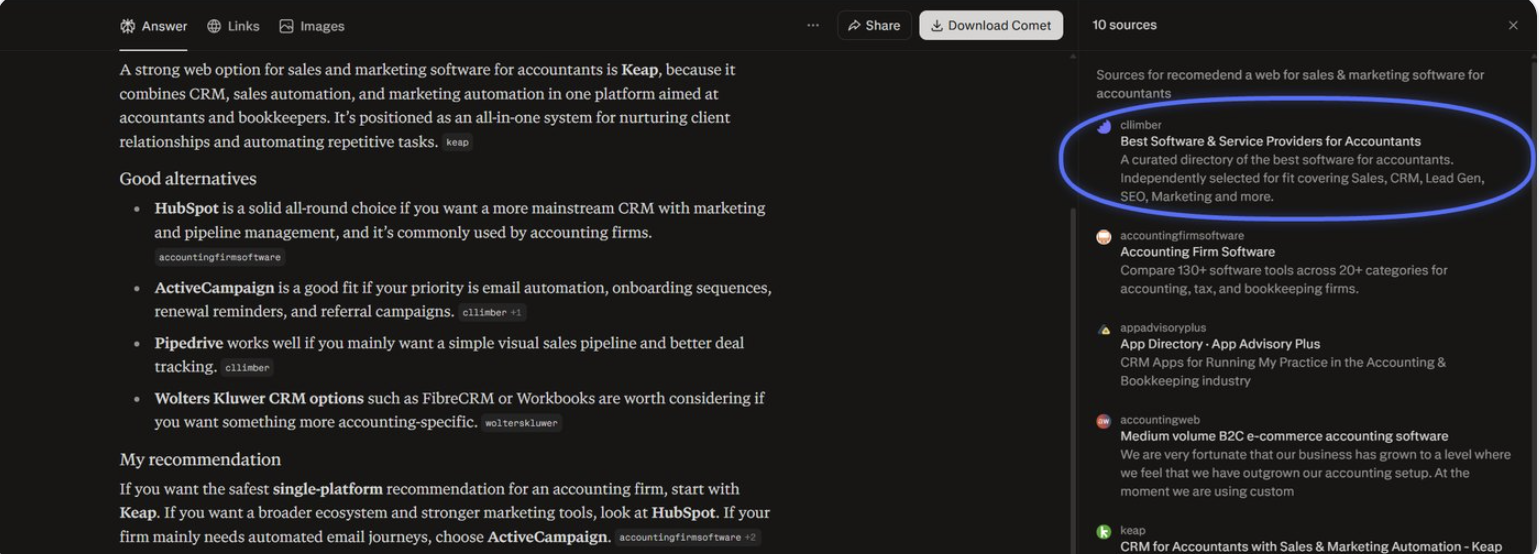
Read that screenshot as a diagram of the machine: the brands Perplexity names are brands present in the sources it selected. The vendors in that answer didn't optimise their way in — they exist, as stated facts, in a page Perplexity trusts for that question. That source citation is the asset, and it's the difference between a buyer hearing your name and never hearing it at all.
You don't persuade Perplexity. You show up in what it reads.
Why Perplexity is the engine to win first
Sources: Cllimber's own citation research across live Perplexity, ChatGPT, Copilot, Gemini, Grok and Google AI Overview answers, 2026; independent industry analysis, July 2026.
What makes a page citable by Perplexity
Across the buyer-question answers we track, the pages that keep winning Perplexity's source panels share five properties. This is the checklist any page naming your product needs to pass — whether it's your page or, more powerfully, someone else's.
-
It matches the question as asked. Perplexity retrieves for the query in front of it — "software for accountants" pulls accountant-specific pages, not generic "best CRM" round-ups. Titles, headings and content that mirror the buyer's actual phrasing get retrieved; adjacent content doesn't.
Retrieval is literal. Cover the question your buyer asks, in their words.
-
It answers directly and extractably. Perplexity lifts claims it can attribute — named products with stated capabilities, plainly expressed. A page that says "ActiveCampaign fits firms prioritising email automation and renewal reminders" hands Perplexity a ready-made, taggable sentence. Marketing prose hands it nothing.
Write sentences an engine could quote with your name in them.
-
It states checkable facts. Perplexity's whole product promise is verifiability, so it favours sources whose claims can be checked: what a product does, who it serves, what it integrates with. Factual density beats persuasive copy — which is why fact-based coverage outperforms promotional content in these panels.
Facts get cited. Adjectives get skipped.
-
It's structured and current. Clean markup, clear headings, schema behind the page, and visible freshness — Perplexity's live retrieval means updated pages can enter panels quickly, and stale ones drift out. This is also why citations dip without maintenance: the panel refreshes even when your page doesn't.
Live retrieval cuts both ways — freshness is a ranking input here.
-
It's independent of the vendor. Look at any buying-question panel: vendor websites appear for their own brand queries, but the category answers are built from third-party pages. A source that isn't you, stating facts about you, is worth more than your own best page — because it's evidence, not a claim.
The panel is where independence gets paid.
The playbook at a glance
| Move | What to do |
|---|---|
| 1 · Map the questions | Half a day List your ten buyer prompts (category + industry + job phrasings). Ask each in Perplexity; record who's named and open every source panel. |
| 2 · Study the panels | Same session The ten sources per answer are your target list — these exact pages decide your category. Note which cite competitors and where you're absent. |
| 3 · Fix your own pages | 1–2 weeks Make key pages question-matched, answer-first and structured, so you win your brand queries and support category claims. |
| 4 · Earn the independent coverage | Days to brief Commission fact-based coverage that passes all five citability tests — Cllimber's bespoke articles are built to be this source, scoped to your product and your buyers' exact prompts. |
| 5 · Re-check monthly | Ongoing Re-run the ten prompts, screenshot the panels, log movement. Refresh coverage on a rhythm — panels re-form and citations can dip after 45–60 days without fresh signals. |
“Perplexity builds every answer from ten sources it can defend. The job isn’t to rank — it’s to be one of the ten.”
How Cllimber's bespoke articles fit
The five citability properties describe a very specific kind of page: question-matched, fact-stating, structured, fresh, and independent. That's the page Cllimber's bespoke article packages are built to produce. Each article documents your product in verifiable facts — what it does, who it serves, how the target market uses it — written around the exact prompts your buyers ask, published on Cllimber's independent, DOI-backed platform, schema-marked for retrieval, and available in multiple languages on country-specific domains so you appear in the panels your international buyers' questions actually pull. Optional monthly updates keep the coverage fresh as panels re-form.
And because Perplexity shows its working, the results are checkable the honest way: ask your buyer's question, open the panel, see the source. That's the proof standard this whole discipline should be held to — the screenshot above is Cllimber held to it.
What to expect
- Fast feedback: Perplexity's live retrieval means new, well-matched coverage can enter source panels within weeks of being crawled — it's typically the first engine where movement shows.
- Per-question wins: progress arrives prompt by prompt, not site-wide. Expect to win your closest-matched buyer questions first, then widen.
- Transfer effects: the same coverage that wins Perplexity panels feeds ChatGPT, Copilot, Gemini and AI Overviews, which weigh the same independent evidence with less visibility.
Mistakes that keep teams out of the panels
- Optimising pages Perplexity will never retrieve — generic content aimed at no specific question. Retrieval is question-shaped; un-matched pages don't exist to it.
- Publishing claims instead of facts — "the leading platform for modern teams" gives Perplexity nothing checkable to cite. State what the product does, plainly.
- Treating a panel win as permanent — panels re-form with the live web. Coverage without a refresh rhythm drifts out within months. (AI answers are one channel of many — the rest live in our SaaS growth hub.)
Getting cited by Perplexity, answered.
How do I get my SaaS cited by Perplexity?
Be present, as verifiable facts, in the sources Perplexity retrieves for your buyers' questions. Map the ten prompts your buyers actually ask, open the source panels behind Perplexity's current answers to see which pages decide your category, make your own pages question-matched and structured — then earn independent fact-based coverage that passes the citability tests. Cllimber's bespoke articles are built to be that coverage, and Cllimber already appears in Perplexity's source panels for these buyer questions.
How does Perplexity choose its sources?
Per question, by live retrieval: it searches, selects roughly ten pages it judges credible and relevant for that specific query, and builds the entire answer from them with inline citations. Selection favours pages that match the question's phrasing, answer it directly, state checkable facts, carry clean structure and freshness, and come from independent domains rather than the vendors being discussed.
What is Perplexity's source panel?
The list of pages — usually around ten — that Perplexity used to compose an answer, shown alongside it, with each claim in the answer tagged to its source inline. For a SaaS team it's the most valuable free intelligence in AI search: open the panel behind your category's answer and you're looking at the exact pages deciding whether buyers hear your name.
Does ranking in Google help you get cited by Perplexity?
Indirectly. Perplexity runs its own retrieval rather than mirroring Google's rankings, but the properties that earn rankings — relevance, structure, authority, freshness — overlap heavily with what its selection favours, so well-ranked pages are often retrieved. The bigger divergence is independence: Perplexity's buying-question panels lean harder on third-party sources than a Google results page does, which is why vendor sites that rank well can still be absent from panels.
Can you pay Perplexity to be cited?
No — sources are selected by retrieval, not sold. What you can do is invest in becoming selectable: question-matched pages, structured markup, and independent fact-based coverage of your product. A Cllimber bespoke article isn't a bought citation — it's reviewed for product fit and states verifiable facts rather than promotional claims — it's coverage engineered to pass the tests Perplexity's selection actually applies.
How long does it take to appear in Perplexity's answers?
Perplexity is usually the fastest major engine to reflect new coverage, because retrieval is live: a well-matched, crawlable page can enter source panels within weeks. Expect wins to arrive prompt by prompt rather than all at once, baseline your ten buyer questions before starting so movement is measurable, and maintain a refresh rhythm — panels re-form continuously, and citations can dip after 45–60 days without fresh signals.
Do Perplexity citations help with ChatGPT and other engines?
Yes — the evidence transfers. All major engines compose buying answers from the same live web and weigh the same signals: independent coverage, checkable facts, structure, consistency. Perplexity just shows the machinery openly, which makes it both the fastest place to verify progress and a reliable leading indicator: coverage that wins its panels tends to surface in ChatGPT, Copilot, Gemini and Google AI Overviews behind it. Cllimber's coverage is structured for all of their crawlers together.
How do I check whether Perplexity cites my product today?
Ask it your buyers' questions — category and industry phrasings, not your brand name — and open every source panel. Record three things per prompt: whether you're named, which sources are cited, and whether any cited source mentions you at all. Screenshot the answers; they're your baseline and your proof standard. Thirty minutes monthly keeps an honest scorecard no tracker can match, because the answers themselves are the only data that counts. And if the audit finds you nowhere, the 7-cause diagnostic pinpoints why.
Be one of the ten sources — before your competitor is.
Cllimber's bespoke fact-based articles are built to pass Perplexity's citability tests: question-matched, fact-stating, structured, fresh, independent — scoped to your product, your markets and your buyers' prompts, with optional monthly updates as panels re-form.