
Content Marketing for SaaS: 9 Tactics That Work in 2026
 JA
JA
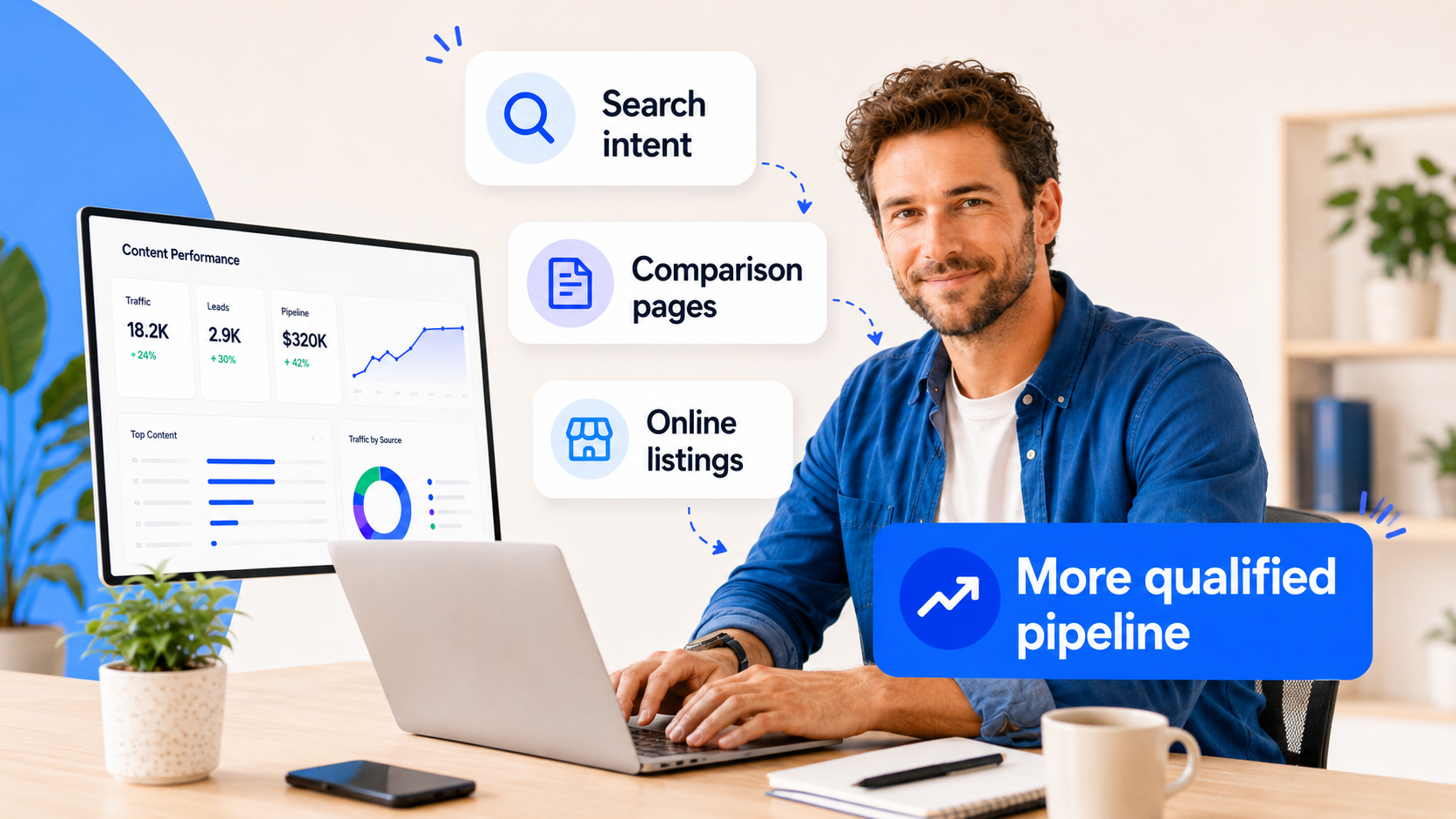
Content marketing for SaaS has changed shape. Buyers no longer only search and scroll; they ask an AI assistant which tool fits their situation and act on the answer. The firms winning in 2026 write content that earns rankings and is structured so AI answer engines can read it, trust it, and surface the product behind it.
This guide sets out nine content marketing tactics that work for B2B SaaS, in the rough order most teams should approach them. None of them is a silver bullet. The pattern that holds across all nine is simple: be genuinely useful at the moment a buyer is deciding, and make that usefulness easy for both search engines and AI answer engines to find.
A note on who is writing this. Cllimber maintains industry-specific directories of the best software and service providers, and publishes research on which create the most advantage per industry, so we have a direct view of how buyers choose. One of the nine tactics below is our own directory; we have flagged that openly where it appears so you can weigh it on its merits alongside everything else.
Effective SaaS content marketing in 2026 spreads across four jobs: earning organic search demand, capturing buyers at the comparison stage, proving value through product-led and customer content, and building third-party credibility that AI answer engines can cite. The strongest programmes pair fast-acting distribution with owned content that compounds.
- Search-led content compounds; paid stops when the spend does. Most SaaS teams need both, but the durable channel is content that keeps ranking and getting cited months later.
- Comparison and "alternative to" pages capture buyers who have already decided to buy and are choosing between options. This is some of the highest-intent traffic in SaaS.
- AI answer engines are now part of the buyer journey. Answer Engine Optimisation and Generative Engine Optimisation mean structuring pages so ChatGPT, Perplexity, and Google AI overviews can read and surface them.
- Third-party presence matters more than ever. Being listed in a credible directory tells AI systems a product is recommended, not just that it exists.
Want buyers to find your software when they ask AI which tool fits their industry?
Cllimber maintains ten industry-specific software hubs, structured for AI answer engines and curated using our published research. Tactic 05 below explains where directories fit in a content strategy. If you already know your product is a fit, you can jump straight to getting listed.
Build search-led content around real buyer intent
Start with the questions your buyers actually type and ask, not the keywords with the biggest volume. For B2B SaaS, the content that compounds answers a specific job: how to solve a problem your product addresses, how to choose between approaches, what a category actually costs. These pages earn rankings slowly and then keep earning them, which is what makes organic content cheaper per lead over time than paid.
Group topics into clusters around the core problem you solve, with one thorough pillar page and supporting articles that link to it. This structure helps search engines understand your authority on the topic, and it gives AI answer engines a clear, well-connected source to draw from. Write each piece to stand on its own: a reader, or an AI system, should get a complete answer without needing three other tabs open.
Win the comparison and "alternative to" stage
The highest-intent content in SaaS is the page a buyer reads once they have decided to buy and are choosing between options. Comparison pages ("X vs Y"), category roundups ("best tools for [job]"), and "alternative to [competitor]" pages catch buyers at the exact moment money is about to move.
Write these fairly. A comparison that only flatters your own product reads as marketing and gets discounted by readers and AI systems alike. Lay out genuine trade-offs, say who each option suits, and let your fit for a specific buyer do the persuading. Fair comparison content earns more trust, and trust is what gets a page cited as a source rather than skimmed and ignored.
Use product-led content: templates, calculators, and free tools
Give buyers something useful before they pay, and let the product show its value in the using. Free templates, calculators, benchmarks, and lightweight tools attract qualified traffic, earn links naturally, and demonstrate competence in a way an article cannot.
The best product-led content sits next to the job your software does, so the step from free tool to paid product is short and obvious. It also tends to attract links and citations, because other people reference a useful tool far more readily than they reference a sales page.
Turn customers into proof with case studies and outcomes
Specific customer outcomes persuade buyers that generic claims cannot. A case study that names the problem, the change, and the measurable result gives a prospect a version of themselves to recognise, and gives AI answer engines concrete, attributable evidence to cite when summarising who a product works for.
Structure each story so the outcome is stated plainly near the top, then supported. Vague testimonials add little; a clear before-and-after with a named customer and a real number does the heavy lifting, in search results and in AI-generated answers alike.
Get listed in industry directories built for AI answer engines
Directories give your product third-party presence at the decision stage, which your own site cannot supply on its own. Optimising your own pages tells search and AI engines you exist; being listed in a credible third-party source tells them you are recommended. The two signals are weighted differently, which is why directories belong inside a content strategy rather than outside it.
The signal is strongest when a directory is both industry-specific and built on published research. This is where our own directory fits, and we are flagging it plainly: Cllimber maintains ten industry hubs, curated using the Cllimber Opportunity Index, a published research dataset, with pages structured for AI answer engines. Because the directory is organised by industry and built on citable research, a listing is positioned to be surfaced when a buyer asks an AI which software fits their sector, rather than sitting on a broad category page with a tag.
The practical takeaway holds whichever directories you choose: a buyer choosing software wants to see your product where they are already looking, described by a source they trust. Industry-specific, research-backed, AI-ready pages give that presence the most weight.
Get your software in the industry hub where buyers ask AI which tool fits
Listed in the relevant Cllimber industry hub, placed in the category where your product is a genuine fit, on research-backed pages structured for AI answer engines. Every product is reviewed for industry fit before going live, and there is no payment until your fit is confirmed.
Optimise for AI answer engines, not just Google
A growing share of buyers asks an AI assistant which software to use and acts on the answer without visiting a results page. Answer Engine Optimisation (AEO) and Generative Engine Optimisation (GEO) are the practices of structuring content so systems like ChatGPT, Perplexity, and Google AI overviews can read it and surface the products it describes.
In practice this means answer-first writing, where the direct answer comes before the elaboration; clean heading structure; schema markup that labels what a page is; and FAQ sections that map to how people actually ask. None of this is exotic. It is the same clarity that helps human readers, made legible to machines. Pages built this way are positioned to be surfaced when a buyer asks an AI which tool fits their need.
Distribute on the channels where your buyers already are
Publishing is not distributing. The best article earns nothing if no one sees it. For B2B SaaS, that usually means a deliberate presence on LinkedIn, in the niche communities and newsletters your buyers read, and through partnerships with adjacent tools and creators who already hold their attention.
Match the format to the channel rather than reposting the same block everywhere. A long guide becomes a thread, a short video, a newsletter section, and a partner co-publication, each shaped for where it lands. Distribution is also where paid social and search ads earn their place: not as the strategy, but as a way to accelerate content that has already proven it converts.
Repurpose deliberately so one idea works many times
A single strong piece of research or thinking should fuel a month of content, not one post. A flagship guide can become a comparison page, a set of social posts, a newsletter, a short video, and a partner contribution, each reaching a different slice of the same audience.
Repurposing is also how small SaaS teams keep pace without burning out. The constraint in most content programmes is not ideas but production capacity, and reworking a proven idea into new formats is far cheaper than originating a new one each time.
Measure what compounds, not just what spikes
Judge content by the pipeline it builds over quarters, not the traffic it spikes in a week. Vanity metrics flatter; the questions that matter are which pieces influence pipeline, which pages get cited or linked, and which channels bring buyers who convert.
Track the assisted role of content, since buyers rarely convert on first touch, and watch for a newer signal: appearances in AI-generated answers and referrals from AI assistants. Programmes that optimise only for last-click will systematically undervalue the content and citations that quietly do the persuading earlier in the journey.
Frequently asked questions about content marketing for SaaS.
What is content marketing for SaaS?
Content marketing for SaaS is the practice of attracting, educating, and converting software buyers through useful content rather than paid placement alone. For B2B SaaS it spans search-led articles, comparison and alternative pages, product-led tutorials and tools, customer proof, and getting listed in credible third-party directories that AI answer engines can cite. The aim is to be present and trusted at the moment a buyer is choosing a tool, whether they search Google or ask an AI assistant.
Which content marketing channels work best for B2B SaaS in 2026?
The channels that compound are search-led content built around buyer intent, comparison and "alternative to" pages, product-led content such as templates and free tools, customer case studies, and presence in trusted directories structured for AI citation. Paid social and ads can accelerate distribution, but the durable advantage comes from owned content and third-party credibility that keep working after the spend stops.
How is SaaS content marketing changing with AI answer engines?
Buyers increasingly ask AI assistants such as ChatGPT, Perplexity, and Google AI overviews which software fits their needs, instead of scrolling a results page. This makes Answer Engine Optimisation and Generative Engine Optimisation part of content marketing: pages need clear structure, answer-first writing, schema markup, and credible third-party citations so AI systems can read them and surface the products they describe.
How do software directories fit into a SaaS content strategy?
Directories give a SaaS product third-party presence at the decision stage. The strongest signal comes from a directory that is both industry-specific and built on published research: when its pages are structured for AI answer engines, they are positioned to be surfaced when buyers ask AI which software fits their industry. A listing tells search and AI engines a product is recommended, not just that it exists, which is a different and heavier signal than self-optimised pages on your own site.
How long does content marketing take to work for SaaS?
Search-led content typically takes several months to compound as pages earn authority and rankings, while distribution-led tactics such as paid social or directory listings can produce visibility much faster. A realistic approach pairs fast-acting placements that create near-term pipeline with owned content that builds a durable, lower-cost channel over the following quarters.
What is the Cllimber directory?
The Cllimber directory is a set of ten industry-specific hubs of the best software and service providers, maintained by Cllimber and curated using the Cllimber Opportunity Index, a published research dataset. Listings are structured for AI answer engines so featured software and service providers are positioned to be surfaced when buyers ask AI which option fits their industry. Every listing is reviewed for industry fit before going live. This article is published by Cllimber, and the directory is our own.
JA