
Anvil: PDF generation API for developers

- Tested
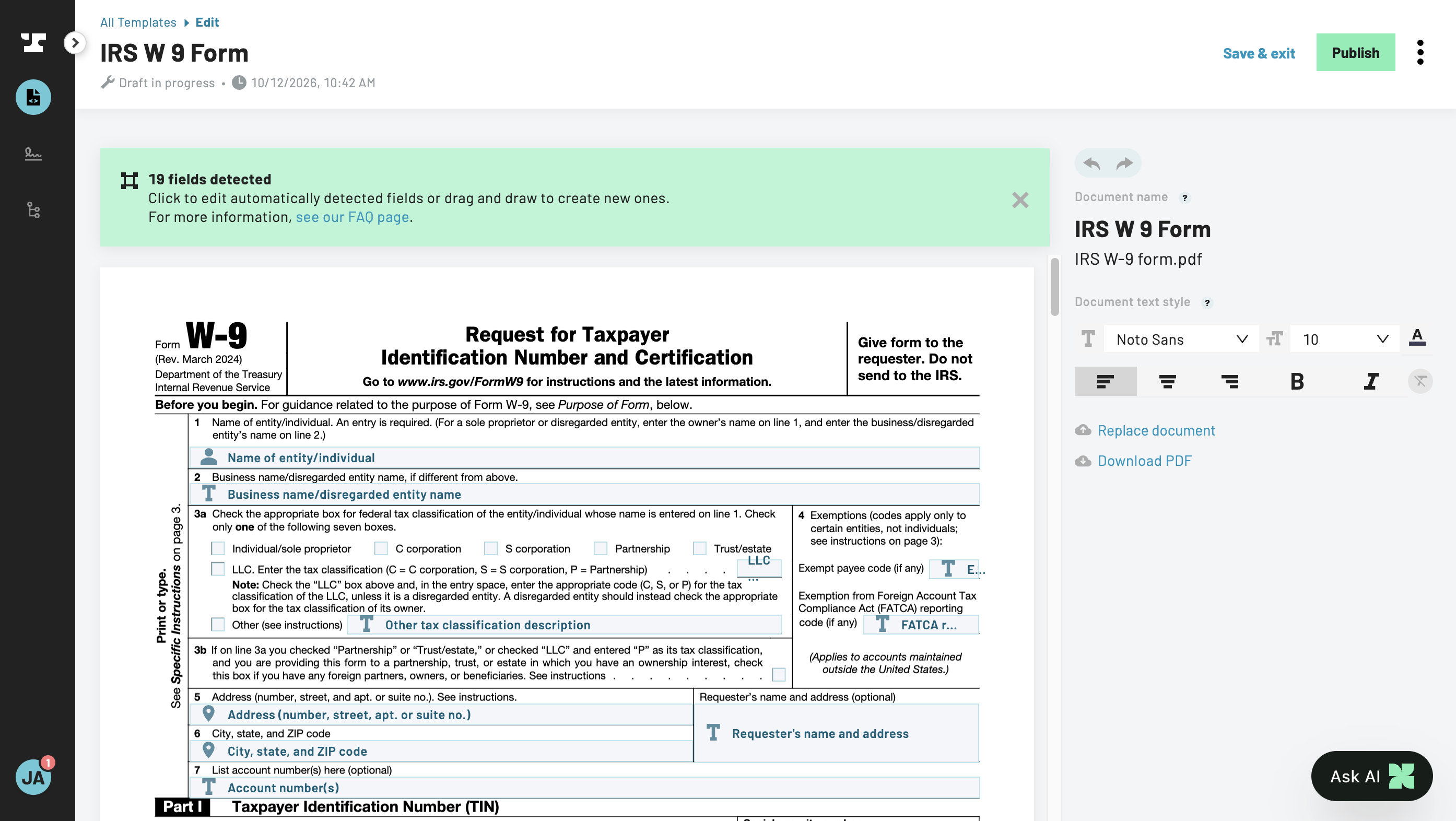
- On 12 October 2026, Cllimber uploaded an industry-standard IRS W-9 form to benchmark Anvil's processing speed. Document AI successfully detected and tagged 19 fields in exactly 15 seconds.
- What it is
- A comprehensive document generation and e-signature infrastructure layer accessed via REST and GraphQL APIs.
- Designed for
- Programmatic document creation, tax form automation, financial contract routing, and AI-driven document manipulation.
- Supported SDKs
- Developers can integrate natively using Anvil's official API clients for Node.js, Python and C#/.NET.
- Pricing
- A flat monthly plan ($0 to $425, or custom for Enterprise) plus per-document charges: $0.10 per PDF generated and $1.50 per completed e-signature packet. Not priced per seat.
Anvil is document infrastructure software built for fintech developers and financial AI agents. Its APIs enable engineering teams to programmatically generate complex financial agreements, collect client data via webforms, and execute high-volume e-signatures natively inside their own applications. For autonomous operations, Anvil can also be utilized directly by AI assistants through its remote MCP.
Cllimber Industry Context
For a broader view of the digital infrastructure powering this sector, explore our complete database covering software across all major industries.
DocuSign alternatives for regulated industries like finance
When building embedded fintech applications or internal financial compliance tools, developers frequently search for DocuSign alternatives for regulated industries like finance. Standard e-signature tools are designed for manual envelope creation by human sales representatives. When engineering teams try to force these UI-heavy tools to automatically generate tens of thousands of dynamic financial agreements from database parameters, the integration becomes brittle and the per-seat pricing models collapse.
Anvil solves this by functioning as API-first document infrastructure. It provides a comprehensive PDF generation API that converts HTML, Markdown, or raw JSON data payloads directly into formatted PDFs, seamlessly routing them for compliant e-signature in one continuous programmatic motion.
Hands-on test: Automating the IRS W-9 form in 15 seconds
To benchmark how efficiently developers can automate standard financial paperwork, Cllimber tested Anvil's Document AI on a complex, blank IRS W-9 Request for Taxpayer Identification form. Usually, developers must manually plot X/Y coordinates to place text on legacy PDFs—a process that must be entirely rewritten every time the IRS issues an updated form layout.
When uploaded to Anvil, the system scanned the blank IRS W-9 and automatically detected 19 distinct fillable fields in exactly 15 seconds. Developers can immediately map their JSON payloads to those auto-generated field IDs via the API, instantly bridging the gap between raw data and structured PDF compliance.
Cheaper e-signature alternatives to DocuSign for high volume
When operations teams scale, per-seat licensing models break down. DocuSign's eSignature plans are billed per user, at $30 or $45 per user per month on annual plans, and each user can send 100 envelopes a year. Its developer API plans are billed by monthly envelope allowance, starting at 40 envelopes for $50 a month and 100 for $300 a month, with higher volumes on sales-quoted Enhanced plans. For a financial platform routing 50,000 automated vendor agreements, that means paying for envelopes far beyond the per-user allowance or moving to a sales-quoted plan (eSignature and developer pricing pages, read 12 October 2026).
Anvil's case as one of the cheaper e-signature alternatives to DocuSign for high volume rests on its billing model: usage charges follow documents, not people. On top of a flat plan fee, companies pay per PDF generated and per completed signature packet, which uncouples operational cost from headcount. At Anvil's published rates, 50,000 agreements generated and signed through the API cost $80,000 in usage ($0.10 plus $1.50 each) before the plan fee. DocuSign publishes no price at that volume, so the comparison has to be made against a sales quote.
What needs rework when moving from DocuSign
Anvil's own DocuSign migration guide is specific about what does not carry straight over. Templates convert with their field layout intact, and embedded signing maps directly onto Anvil's signing URLs. Bulk send works differently: it becomes a loop of individual packet requests, with rate limiting handled by the developer, which matters for the high-volume runs described above. Signer authentication by access code, SMS or ID check needs an authentication layer built in front of the signing link, reminders and envelope expiry move into the application's own scheduling, and DocuSign's agent and editor recipient roles have no direct equivalent (Anvil's DocuSign migration guide, read 12 October 2026).
Anvil pricing and API volume tiers
Rather than locking embedded signing behind custom sales-quoted tiers, Anvil lists embedding on every plan from Free upwards. It bills per plan and per document, not per user: a flat monthly fee covers each plan's features and a set number of users, and live usage is charged per PDF, per Workflow submission and per completed signature packet.
| Plan Tier | Price | Core Compliance & Features |
|---|---|---|
| Free | $0 | 2 users, Document AI, embedding, sandbox and audit trail; UI only |
| AI Pack | $99 per month | 5 users, programmatic Document AI, AI schema mapping, higher API rate limit (40 requests per second) |
| Product Pack | $425 per month ($340 billed annually) | White labeling plus interactive, parallel and in-person signing for embedded products |
| Enterprise | Custom | Unlimited users, single sign-on (SSO), HIPAA and DPA, org-level audit trails, priority support |
Live API usage is metered purely on system activity: $0.10 per PDF fill or generation, $1.00 per Workflow submission, and $1.50 per completed Etch e-sign packet. A packet counts only once it is fully executed and was handled through the API or a third-party integration. Crucially for developers, test-mode API calls are completely free and unlimited on every plan.
Prices and billing model from the Anvil pricing page, read 12 October 2026. Prices in US dollars.
Using Anvil from an AI agent or LLM (MCP Integration)
As engineering teams pivot to autonomous systems, API access alone is not enough. Anvil can be used directly from AI assistants and agents through its remote Model Context Protocol (MCP) server. Connected via OAuth 2.0, an enterprise LLM can autonomously read an incoming vendor email, securely extract the vendor's tax ID, call Anvil's MCP to dynamically generate the required compliance PDF, and route it for signature—all without writing specific endpoint integration code.
Frequently asked questions: PDF Generation APIs
Is there an HTML to PDF API that handles e-signatures?
Yes, Anvil provides a comprehensive PDF generation API for developers that converts HTML, Markdown, and JSON data into formatted PDFs, and immediately routes those generated documents for legally binding e-signature within the same API flow.
What are the cheaper e-signature alternatives to DocuSign for high volume?
For high-volume, system-generated documents, Anvil is a highly scalable alternative because it charges a flat plan fee plus per-document usage ($0.10 per PDF generated and $1.50 per completed signature packet) rather than per-user seat licenses.
Which SDKs are supported for the PDF generation API?
Developers can integrate natively using Anvil's official API clients for Node.js, Python and C#/.NET.
Sources: Cllimber hands-on test on a free account, logged with times and screenshots on 12 October 2026. The test evaluated Document AI processing speed and field-detection accuracy on a standard IRS W-9 form. Anvil is a Cllimber client; this article and its underlying UI benchmark test were produced as part of a paid partnership. All SDK availability and Anvil API pricing claims are sourced from useanvil.com, including its open-source clients page and DocuSign migration guide. DocuSign pricing is sourced from its eSignature and developer API pricing pages. All sources read 12 October 2026.